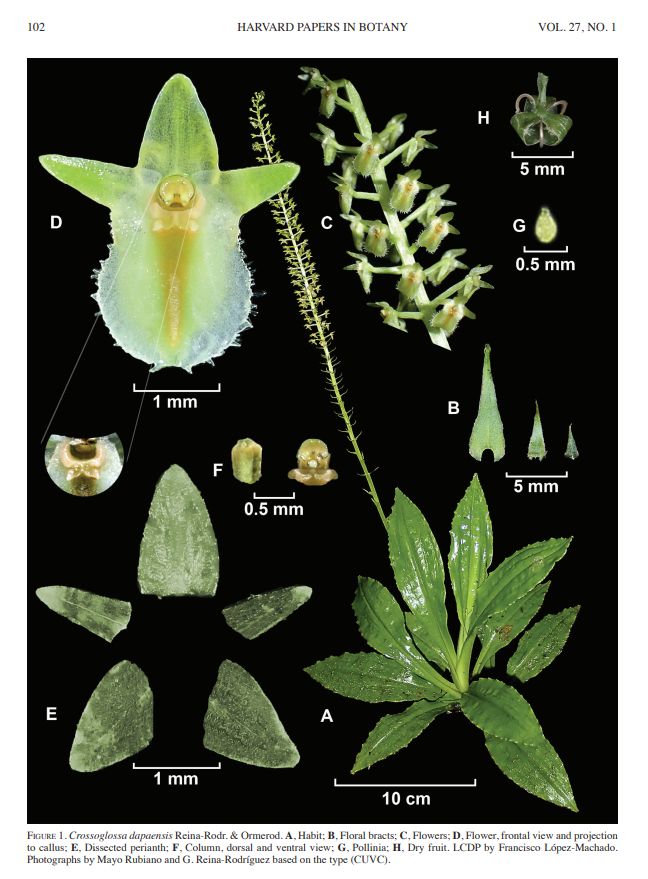
Crossoglossa dapaensis Reina-Rodr. & Ormerod 2022
LCDP TYPE Photo by © Mayo Rubiano and G. Reina-Rodríguez and Harvard Pap. Bot. 27: 101 Reina-Rodr. & Ormerod 2022

 LATE
LATE EARLY
EARLY 
Common Name The Dapa Hills Crossoglossum [A locality in Valle de Cauca department of Colombia]
Flower Size .12" [3 mm]
Found in Valle de Cauca department of Colombia in montane rain forest at elevations around 2000 to 2250 meters as a small sized, cold growing terrrestrial with an elongate, terete rhizome giving roise to a short stem carrying 10 to 13, (possibly each new stem 5 to 6 leaved), oblong-elliptic, basal third subpetiolate to sessile, acute, margin laxly undulate, mid-green above leaves that blooms in the late summer and early spring on an erect, terminal, peduncle c. 5.28" [13.2 cm] long, rachis 38.8 to 44.8" [97 to 112 cm] long, densely, simultaneously many flowered inflorescence with about 80 to 95% of the flowers open and with lanceolate, apiculate, irregular margined mostly longer than the ovary floral bracts.
" This species is most closely related to Crossoglossa liparidoides , a species of uncertain origin (most likely from Ecuador). Both taxa share floral size (sepals c. .08" [2 mm] long) and lip callus shape, but C. dapaensis is a much larger and leafier plant, with broader petals and an obovate-elliptic (vs. elliptic) lip. Another florally similar species is from Ecuador, Peru, and Bolivia. It is, however, a short 1.2 to 2.2" (30 to 55 mm) long stemmed, densely leaved plant, with smaller 1.52 to 4.8" x .32 to .52" (38 to 125 × 7.5 to 13.0 mm), narrower leaves, slightly larger (dorsal sepal .096 to .110" [2.40 to 2.75 mm]) long flowers, and ligulate petals. Crossoglossa polyblephara from Colombia is also florally similar, but it too is a short (1.2" [30 mm] long) stemmed, densely leaved plant, with smaller 2.4 to 4.4 x .4 to .52" (60 to 110 × 10 to 13 mm), narrower leaves, also the lip bears a semilunate callus. A fourth florally and vegetatively similar species is Crossoglossa zarucchii. The figure in the protologue of C. zarucchii shows the lip to be oblong-subpandurate, and the callus to have small oblong lobules. However, study of the isotype in MO shows the lip to be obovate-elliptic, weakly subpandurate, prominently papillose-ciliate margined, and the callus to be transversely lunate (i.e., with acute, divaricate, ligulate-lanceolate arms). In C. dapaensis the lip callus differs in having obliquely ovate lobules like those found in C. dalstroemii and C. liparidoides." Reina-Rodr. & Ormerod 2022
Synonyms
References W3 Tropicos, Kew Monocot list , IPNI ;
* Harvard Pap. Bot. 27: 101 Reina-Rodr. & Ormerod 2022 photo fide;
Materials to the Orchid Flora of Colombia Vol IV:68 Szlatchetko & Kolanowska 2023 drawing fide
----------------------------------------------------------------------------------------------------------
------------------------------------------------------------------------------------------------