![Ascocentrum ampullaceum [Lindley]Schlecter 1913](orphotdir/ascocentrumampullaceum.jpg)


![Cadetia taylori [F. Mueller]Schlecter 1912](orphotdir/cadettaylori.jpg)


 to
to 
Any of the plants below can be had for $11 each!! 5 for $50
SPECIES
Angraecum calceolus Thouars 1822
Flower Size 1/4 to 3/8"
A small, epipytic or lithophytic, warm growing orchid found in coastal forests at elevations of 30 to 60 meters that blooms in the summer on a racemose to paniculate, 6 to 10" long inflorescence with laxly few to several flowers and all shorter than the leaves that is found in Mozambique, Madagascar as well as the Indian Ocean Islands Of Comoros, the Mascarenes and the Seychelles. This is one of two species that is found in Africa as well as the Indian Ocean Islands and is unusual in that, with older specimens, it is possible to have a branched inflorescence.
Synonyms Aeranthes calceolus (Thouars) S. Moore 1877; Aeranthus calceolus [Thou]S. Moore; Aerobion calceolus (Thouars) Spreng. 1826; Angraecum anocentrum Schlechter 1898; Angraecum rhopaloceras Schlecter 1925; Epidorchis calceolus [Thou] O.Ktze 1891; Macroplectrum calceolus [Thou] Finet 1907; Mystacidium calceolus (Thouars) Cordem. 1895
Ascocentrum ampullaceum [Lindley]Schlecter 1913
Flower Size 1/2" to 1 1/4" [1.5 to 2.5 cm]
A great mini vandaceous plant, spring through summer bloomer on axillary, 3 to 8" [8 to 20 cm] long, shorter than the leaves, compact inflorescence that have many small flowers, found Nepal thru Thailand at elevations of 300 to 900 meters often on deciduous trees. Warm to cool temperatures and high humidity as well as bright light are required. It likes wood slat basket culture and needs a slight drying out and cooling in the winter.
Synonyms *Aerides ampullaceum Lindley 1832; Gastrochilus ampullaceus O.Ktze. 1891; *Saccolabium ampullaceum Lindley 1828
Brassia verrucosa In a 2" clay pot and is a seedling 2 years out of flask.
This large species is a warm to cool growing epiphyte of open humid forests from altitudes of 900 to 2400 meters that range into Mexico, Guatemala, and Honduras. It is distinguished from the other Brassia by the green warts on the base of the lip. They flower in the late spring through the early autumn on a basal, long, erect to arching, inflorescence which are loosely few flowered but arranged in pairs and are slightly fragrant and need regular waterings and fertilizer year round.
Brassia caudata In a 2 to 3" clay pot and is a seedling 2 years out of flask
Found from Florida south through the Caribbean and all of central America south to Peru as a caespitose, bifoliate epiphyte at elevations of sealevel to 1200 meters where it blooms on an arcuate, 8 to 10" [15 to 25 cm] long, many flowered inflorescence arising on a mature psuedobulb and occuring in the spring.
Cadetia taylori [F. Mueller]Schlecter 1912
Flower Size Less than 3/4" [1.5 cm]
This species is from Eastern Australia and New Guinea and found at sealevel up to 1400 meters on trees and rocks in tropical rainforest, open forest and in mangrove swamps and is a hot to warm growing small, densly tufted, epiphytic plant, with pencil like pseudobulbs that blooms repeatedly in the spring through fall at the base of the leaf and the top of the psuedobulb with a small, short-lived, solitary flower, opening in succession one at a time and needs moderate shade and plenty of water while growing and a lessening after maturity. Potting or mounting on tree fern are fine as well as cold to warm temperaturer and high humidity and watering year round.
Synonyms *Bulbophyllum taylori F. Meuller 1874; Cadetia hispida (A. Rich.) Schltr. 1912; Callista hispida (A. Rich.) Kuntze 1891; Dendrobium hispidum A Rich. 1834; Dendrobium taylori [F. Mueller]Fitz. 1884; Dendrobium uniflos F. M. Bailey 1884
Cattleya bowringiana Veitch 1885
to
Common Name Bowring's Cattleya
Flower Size 3" [7.5 cm]
Belize and Guatemala are the home to this cool to warm growing lithophyte found at elevations of 210 to 900 meters on rocky cliffs near fast moving streams with a humid atmosphere that blooms in the fall on a terminal, erect or nodding, long-stalked, few to many flowered, sheathed inflorescence that is not long lasting and gives rise to up to 15 flowers. It requires a short winter rest from water and fertilizer after the completion of flowering.
Synonyms Cattleya autumnalis Hort. 1885; Cattleya skinneri Bateman var. bowringiana (Veitch) Kraenzl. 1892
Cattleya harrisoniana Bateman ex Lindley 1836
Another Clone Photo courtesy of Dale and Deni Borders.

 to
to
Common Name Harrison's Cattleya
Flower Size 4 1/2" [11.25 cm]
This is a epiphytic or lithophytic, warm growing species found in humid swampy areas on bushes that blooms in the late summer on a terminal, short, few to several [2 to 6] flowered inflorescence subtended by a green sheath with fragrant, long-lived, waxy flowers and needs ample water, warmth and light while growing and a good rest after maturity.
Synonyms Cattleya brownii Rolfe 1894; Cattleya harrisoniae Batem. 1838; Cattleya harrisoniae Paxt 1838; Cattleya harrisonii P.N.Don 1840; Cattleya intermedia var variegata Hkr.; Cattleya loddigesii var. harrisoniana Lindley 1887; Cattleya papeinsiana C. Morr. 1845; Epidendrum harrisonianum Rchb.f 1861
Cattleya schroderae Sander 1888 var alba
Different Color Variety Photo courtesy of Patricia Harding
to 
10.00 NBS 2" plastic pot 4 to 6" NBS
Common Name Baroness Schroder's Cattleya in Colombia; Cattleya de Pascua or Easter Cattleya
Flower Size 9" [22.5 cm]
Differs from Cattleta trianeae by the abscence of club shaped psuedobulbs, the larger flowers and the prominent orange spot on the crisper lip and is a Colombian hot to cool growing species that blooms in the spring on a short, erect, few flowered inflorescence held close to mid-leaf.
Synonyms Cattlya labiata var schroderae Sander 1888; Cattleya trianaei var schroederae Rchb.f 1887
--------------------------------------------------------------------------------------------------------------
Chysis laevis No photo but they are 8" tall and in a 2" plastic pot.
It is supposed to be yellow to orange and about 2" in flower size.
Encyclia chacaoensis (Rchb. f.) Dressler & G.E. Pollard 1971
toMID to EARLY
Flower Size less than 2" [less than 5 cm]
Found from Nicaragua to Colombia and Venezuela as a hot to warm growing cockleshell epiphyte or lithophyte from oak forests at elevations of sealevel to 1400 meters where it blooms in the midwinter till early summer on an apical, 2 to 7 flowered, short, racemose inflorescence subtended by a basal sheath.
Synonyms Encyclia ionophlebia (Rchb. f.) Dressler 1961; *Epidendrum chacaoense Rchb
Epidendrum calanthum Rchb. f. & Warsz. 1854
Flower Size 1" [12 cm]
Colombia, Venezuela, Peru, Bolivia and Ecuador are the locales for this pretty, reedstem terrestrial or lithophyte from elevations of 700 to 2200 meters in tropical montane forests where it blooms on a terminal, 7" [17.5 cm] long, few flowered, subumbellate inflorescence arising on a mature stem that occurs in the late spring and summer and is an hot to cool growing orchid that likes wet humid conditions and can take some full sun.
Synonyms Epidendrum caucae Schltr. 1920; Epidendrum chrysostomum Rchb. f. 1856; Epidendrum decipiens Lindl. 1853; Epidendrum filomenoi Schltr. 1921; Epidendrum fulgens Brongn. 1834; Epidendrum huanucoense Schltr. 1921; Epidendrum ibaguense var. confluens (Lindl.) C. Schweinf. 1944; Epidendrum laetum Schltr. 1919; Epidendrum paytense Rchb. f. 1855; Epidendrum pristes Rchb. f. 1886; Epidendrum schomburgkii var. confluens Lindl. 1853
Jumellea arachnantha [Rchb.f]Schlecter 1915
Found on the Comoros Islands as an epiphyte where it blooms on a shorter, axillary, erect, single flowered inflorescence.
Synonyms *Aeranthes arachnanthus Rchb. f.1885
Laelia fidelensis Pabst 1967
Common Name Saint Fidel's Laelia
A summer blooming dwarf Brazilian epiphyte that is a cool to warm grower that blooms with a 2 flowered raceme occuring in nature in summer in cultivation and in winter in Brazil.
Synonyms Sophronitis fidelensis (Pabst) C. Berg & M.W. Chase 2000
Laelia purpurata var carnea Lindley 1852-3
A light hot pink lip on a white flower.
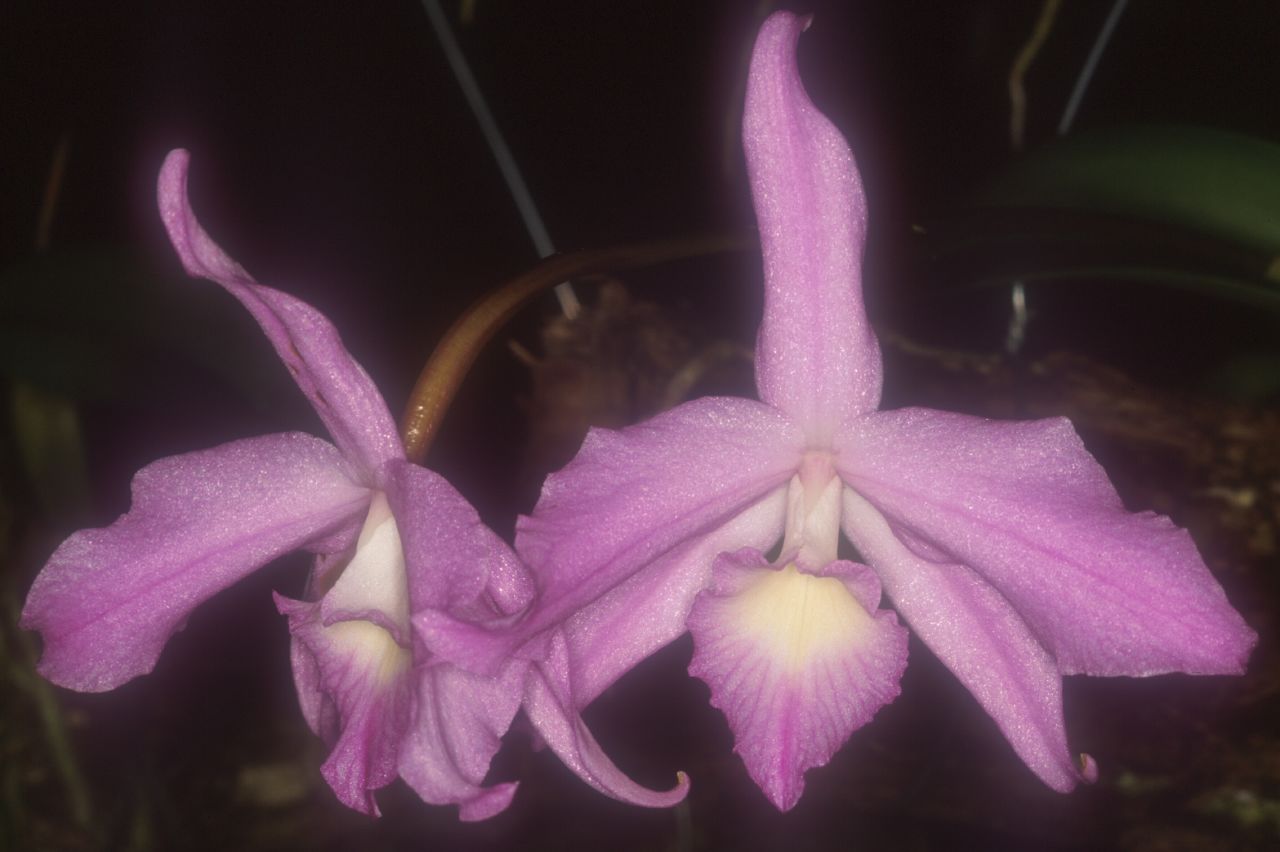
Laelia tenebrosa [Rolfe]Rolfe 1893
<
Common Name Dark Laelia
Flower Size 6 1/2" [16.25 cm]
Found in Brazil this hot to cool growing species with a solitary leaf and has a 6" [15 cm]long raceme with a large sheath and 3 to 4 fragrant, short-lived, color variable flowers which occur from June til August.
Synonyms *Laelia grandis Lindley & Paxton var tenebrosa Gower 1891; Sophronitis tenebrosa (Rolfe) C. Berg & M.W. Chase 2000
Pleurothallis sonderana Rchb. f. 1849
Another View Photos courtesy of Jay Pfahl
Flower Size 1/16" [7 mm]
A miniature epiphyte found in Brazil on branches and trunks of trees in cool, moist montane forests with terete leaves and short [3 cm], erect, few [p3 to 5] flowered inflorescence arising from the apex of stalk occuring in the summer and winter. I grow mine in a pot with sphagnum moss in a shaded location with some dappled sun, warm to cool temperatures and ample water o keep moist at all times.
Holcoglossum kimballianum (Rchb. f.) Garay 1972
Common Name Kimball's Holcoglossum
Flower Size about 2" [3.5 to 5 cm]
This is a pendant, hot to warm growing epiphyte from Thailand Burma, and south China at elevations of 1200 to 1800 meters mostly on rocks in exposed locations but occaisionally on trees in partial shade that blooms on an axillary, 1 1/2' [20 to 45 cm] long, laxly few to several [to 20] flowered, racemose inflorescence with elliptic bracts and fragrant, long-lived flowers. Best mounted on cork or tree fern, given cool to warm temperatures, bright light and plenty of water while growing and a short dry rest in the winter
Synonyms *Vanda kimballiana Rchb. f. 1889
Renanthera monachica Ames 1915
Common Name Spanish Dancing Girl Renenthera
Flower Size 1 to 1 1/2" [2.5 to 4 cm]
This is a Philippine species from the island of Luzon at elevations up to 500 meters that is a warm to hot growing epiphyte and it blooms on an axillary, suberect, simple, 1 1/2' [45 cm] long, laxly racemose inflorescence that has tubular bracts, occuring in the late winter and spring with many [6 to 30], non-fragrant, long-lasting flowers. It is a monopodial, vandanaceous, medium sized epiphyte with an axillary inflorescence and does best in a wood slat basket with little or no medium.
Trudelia pumila (Hook. f.) Senghas 1988
to and EARLY
Flower Size 1 to 2 1/2" [2.5 to 5 cm]
Closely related to V. cristata. A hot to warm growing epiphyte in the lowlands of the Himalayas at elevations of 500 to 1000 meters that blooms on an erect, 6" [10 to 20 cm] long, loosely few [1 to 5] flowered inflorescence with heavy textured, fragrant flowers occuring in the spring and early summer. Best grown in a wood slat basket with bright light, hot to warm tempeartures, high humidity, and plenty of year round water.
Synonyms Vanda pumila Hook. f. 1896
Vanda luzonica Loher ex Rolfe 1915
Common Name The Luzon Vanda
Flower Size 2 1/2 to 3" [6 to 7 cm]
Found on the isle of Luzon in the Philippines at elevations of 500 meters, as a hot to warm growing monopodial epiphyte that likes steady watering year round and blooms on an axillary, descending, to 16" [40 cm] long, shorter than the leaves, several to many [10 to 25] flowered inflorescence occuring in the spring with fragrant, very waxy flowers.
!Vandopsis parishii (Rchb. f.) Schltr. 1912
Flower Size 2 1/2" [6 cm]
A large, warm to hot growing, epiphytic orchid that is found in Burma and Thailand in deciduous forests at altitudes up to 1300 meters and blooms on an axillary, 1 1/2' [45 cm] long, 5 to several flowered inflorescence with fragrant heavy textured, long lasting flowers, that is longer than the leaves occuring in the spring, summer and fall.
Synonyms Hygrochilus parishii (Rchb. f.) Pfitzer 1897; Stauropsis parishii (Rchb. f.) Rolfe; *Vanda parishii Rchb. f. 1868
-----------------------------------------------------------------------------------
------------------------------------------------------------------------------------------------------------------------------------------------------------------------------------------------------
The following species are at individual prices but if you get 5 plants total all 11.00 plants that you choose will be 10.00 but the following stay at the price quoted.
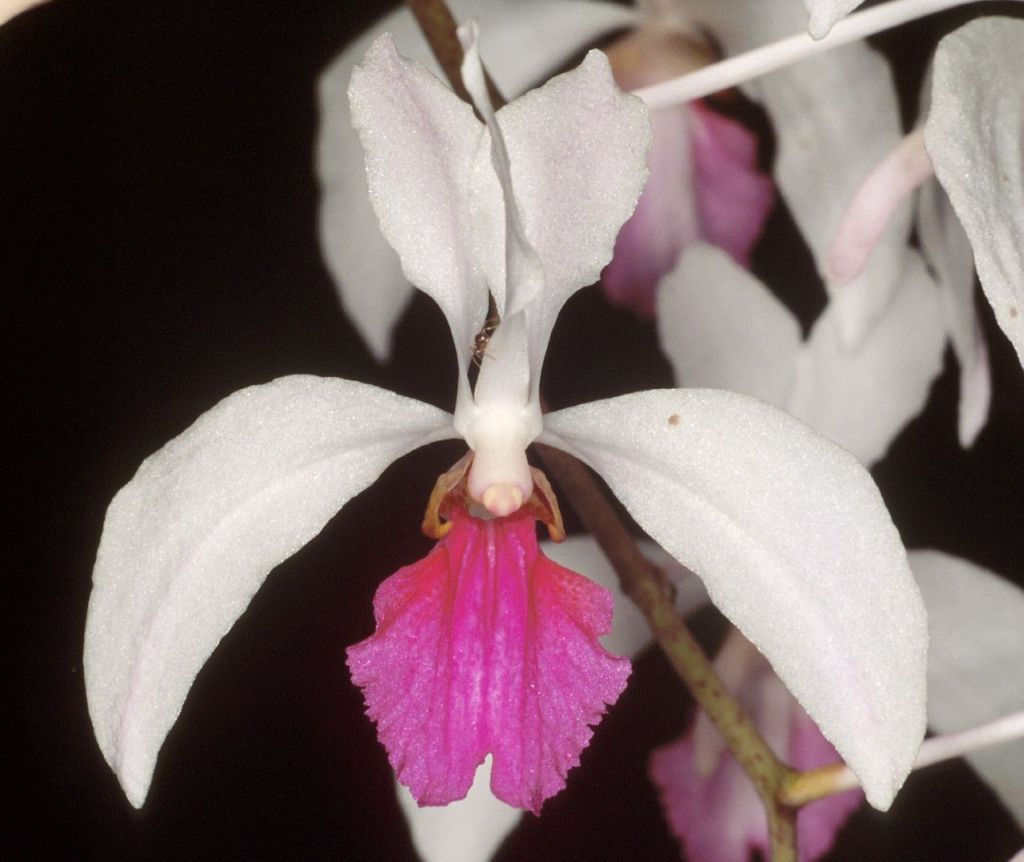
Aerangis articulata [Rchb.f]Schlecter 1914
15.00 NBS
Flower Size 1 1/4" to 2" [3 to 4 cm]
A Madagascan epiphytic, hot growing species that is quite showy when it blooms in the spring and summer on an axillary, 9 to 18" [22.5 to 45 cm] pendant inflorescence with up to 18 scented, long-lived, waxy flowers.
Synonyms Angorchis articulata (Rchb. f.) Kuntze 1891; *Angraecum articulatum Rchb.f 1872; Angraecum descendens Rchb.f 1882; Rhaphidorhynchus articulatus (Rchb. f.) Poiss. 1912
Aerangis macrocentra (Schltr.) Schltr. 1915
15.00 NBS
Flower Size
Endemic to central Madagascar at elevations around 1400 meters as an warm to cool growing, smaller epiphyte that blooms on an axillary, 6" long, several flowered inflorescence.
Synonyms Aerangis clavigera H. Perrier 1938; *Angraecum macrocentrum Schltr. 1913
Ancistrochilus rothschildianus O'Brien 1907
 to
to
16.00 NBS
Flower Size 2" to 3" [5.5 cm]
A small, sympodial, epiphytic plant, with pseudobulbs that look like Hershey's kisses. It is a cool to hot grower from Guinea, Sierra Leone and across to Uganda on bare trunks and larger branches of large forest trees at elevations of 500 to 1100 meters that can be potted and watered regularly while growing and less when not. The arching, to 8" long, pubescent inflorescence, form from the base of the leafed or leafless psuedobulb and can carry 2 to 5 large, fragrant flowers occuring in the winter, summer and fall.
Synonyms Pachystoma rothschildiana (O'Brien) Sander 1927
Angraecum distichum Lindl. 1836
14.00 Blooming size miniature NEAT!!
Flower Size 1/4" [.6 cm]
Found in Central Africa, specifically Gabon and Cameroon as a hot and humid growing, small Lockhartia-like epiphyte from elevations of 200 to 1600 meters that blooms on a very short, axillary, solitary flowered inflorescence with long-lived, fragrant flowers occuring at any time of the year on new leaves and most often more than one. Cuttings can be made of side branches as they will root out quickly if potted in a standard bark mix with high humidity and fairly heavy shade.
Synonyms Aeranthes distichus (Lindl.) Rchb. f. 1864; Epidorchis disticha (Benth.) Kuntze 1891; Limodorum imbricatum Sw. 1805; Macroplectrum distichum (Lindl.) Finet 1907; Mystacidium distichum (Lindl.) Benth. 1881
Barkeria halbingeri Thien 1973
12.00 in pots NBS but soon
Flower Size 2 1/4" [4.5 cm]
Found in Mexico in the state of Oaxaca as a lithophyte where it blooms on a 6" [15 cm] long, many flowered, racemose inflorescence occuring in the spring. Even though it is a lithophyte it does well mounted to wood and given hot to cool conditions with bright light and a reduction of fertilizer and water in the winter.
Brassavola cordata Lindley 1836
18.00 Mounted larger NBS
Flower Size 1 3/4" [4.15 cm]
Common Name Heart-lipped Brassavola
From Jamaica, a medium sized epiphyte that is a late summer to fall bloomer on a branched, 6" [15 cm] long raceme that carries up to 6 long-lived flowers that smell of citrus only at night. Grows best mounted on wood and likes some shade and watering while in growth and a lessening after the psuedobulbs have matured and the plant has flowered.
Synonyms Bletia cordata [Lindley] Rchb.f 1862; Bletia nodosa var cordata [Lindley] Rchb.f 1863;Brassavola harrisii Jonews 1969; Brassavola nodosa Hkr. not Lindley 1833; Brassavola nodosa subsp. cordata (Lindl.) N.H. Williams; Brassavola sloanei Griseb. 1864; Brassavola stricta Hort 1885; Brassavola subuliflolia Lindley 1831; Lysimnia bicolor Raf. 1836
!Brassavola cucullata [L.] R.Br. 1813
to
15.00 NBS mounted, medium sized plants, a year away from blooming
Common Name Hooded Brassavola
Flower Size 7" [17.5 cm]
One to two flowered epiphytic plant that smells somewhat skunky at night, grows best mounted on wood and comes from the West Indies, Central and northern South America where it is a warm to cool growing epiphyte of coastal rainforests up to 1800 meters in elevation where it blooms from summer till autumn on a short peduncle that is borne at the junction of the single leaf and terete psuedobulb. Flowers that appear later in it's season and exposed to a cold snap will have a redder appearance. This is the type species for the genus.
Synonyms Bletia cucullata (L.) Rchb. f. 1861; Brassavola appendiculata A. Rich. 1845; Brassavola cucullata [L.]R.Br. var cuspidata [Hkr.] LIndley 1887; Brassavola cucullata [L.]R.Br. var elegans Schlecter 1919; Brassavola cuspidata Hooker 1839; Brassavola elongata Hort. 1954; Brassavola odorattissima Regel 1852; Cymbidium cucullatum Sw. 1799; *Epidendrum cucullatum L. 1763
-------------------------------------------------------------------------------------------------------
Cattleya aurantiaca [Bateman ex Lindley]P.N.Don 1840
to to 
18.00 NBS
Common Name Orange Cattleya
Flower Size 1 /2" [2.5 cm]
This stout epiphytic and occasional lithophytic species is found in El Salvador and Mexico at elevations of 300 to 1600 meters in tropical and lower mountain rain forests on exposed rocks, or on trees in areas of extreme heat and cold and it grows warm to cool and flowers from summer till autumn on a terminal, 6 1/2" [16 cm] long, few to many flowered, umbelliform inflorescence arising on a mature psuedobulb. This plant's flowers are the smallest in the genus and can self-pollinate which causes the flowers to not open fully. This species and C. skinneri naturally hybrid to create C. guatemalensis.
Synonyms Broughtonia aurea Lindl. 1840; *Epidendrum aurantiacum Batem. ex Lindley 1838; Epidendrum aureum Lindley 1853
-------------------------------------------------------------------------------------------------------------------------------
Cattleya bicolor Lindley 1836 var brazilensis
12.00 4 to 5" 2" plastic pot NBS
Common Name Bicolored Cattleya
Flower Size 4" [10 cm]
This is a Brazilian native species that is a cool to warm growing orchid which blooms in the fall, winter and spring on a terminal, short 1 to several flowered inflorescence with a large sheath giving rise to a heavy texturede, highly fragrant, long-lived flower and is not often seen in hybridizing.
Synonyms Cattleya grossii Kraenzl. 1897; Cattleya measuresiana (Lindl.) Blumensch. 1861; Cattleya tetraploidea Brieger 1978; Epidendrum bicolor Rchb.f 1861; Epidendrum iridee Desc. 1821
Cattleya deckeri Klotsch 1855
to
20.00 NBS
Common Name Decker's Cattleya
Flower Size 3 1/2" [8.75 cm]
Found in Panama to Trinidad at elevations of 0 to 900 meters and is the only Cattleya found in both Central and South America on trees along riverbanks and under bushes on rocks and blooms in the fall on a 5 1/2" [13.75 cm] long, erect, several flowered racemose inflorescence with slightly fragrant flowers. The fall flowering separates it from Cattleya skinneri with which it is often confused.
Synonyms Cattleya patinii Cogn. 1900; Cattleya skinneri var autumnalis Allen 1942; Cattleya skinneri var parviflora Hkr. 1856; Cattleya skinneri var patinii 1914
Cattleya elongata Barb. Rodr. 1877
18.00 This is a large plant NBS-BS But soon, this year, most likely. It is in a 4" plastic pot with 4 mature pseudobulbs with the largest being 8" including the leaves.
Common Name Cattleya with the Elongated Stalk
Flower Size 3" [7.5 cm]
A Brazilian bifoliate species found on rock outcroppings with bright light that has a terminal, 2" [5 cm] long , 2 to several [10] flowered inflorescence with fragrant, long-lived, heavy-textured,color variable flowers occuring in the late summer.
Synonyms Cattleya alexandrae Linden & Rolfe 1892
!Cattleya labiata Lindley 1821
Plant and flowers Photo Courtesy of Jean Claude George
NBS 5 to 7" 2" plastric pot 14.00
Common Name Crimson or Ruby Lipped Cattleya
Flower Size 7" [17.5 cm]
A Brazilian, variable sized epiphyte that blooms mostly in the fall and early winter on a short, few [2 to 5] flowered inflorescence subtended with a double, leathery sheath and is a cool to warm growing orchid species.
Synonyms Cattleya bullieri D.J. Carr 1886; Cattleya labiatum Rchb.f 1861; Cattleya labiata var autumnalis Linden 1887; Cattleya labiata var genuina Stein 1892; Cattleya labiata var warocqueana Rolfe 1890; Cattleya labiata vera Veitch 1887; Cattleya leeana Sander 1883; Cattleya lemoniana Lindley 1846; Cattleya massangeana Rchb. f. 1883; Cattleya morganae Warner 1882; Cattleya nalderiana Rchb. f. 1885; Cattleya pallida Lindl. & Paxton 1851-2; Cattleya peetersii André 1885; Cattleya regalis hort. 1883; Cattleya rochellensii Rchb. f. 1888; Cattleya rollissonii T. Moore 1861; Cattleya wallisii L. Linden & Rchb. f. 1882; Cattleya warocqueana L. Linden 1890
Cattleya lawrenceana Rchb. f. 1885
Another color form Photo courtesy of Dale Borders
to
18.00 NBS but some are starting to Soon
Common Name Sir Trevor Lawrence's Cattleya
Flower Size 5" [12.5 cm]
This is a Venezuelan and Guyanan species found especially atop Mount Roraima at elevations around 250 to 3000 meters as a hot to cool growing epiphyte epiphyte that blooms in the spring and early summer on a usually erect, terminal, racemose, few to several [5 to 8] flowered inflorescence subtended by a broad brownish-purple sheath.
Cattleya loddigesii Lindl. 1823
18.00 NBS But Soon!
Common Name Loddiges' Cattleya
Flower Size 4 1/2" [11.25 cm]
A cool to warm growing, bifoliate epiphyte or lithophyte that is from near the coast from Bahia Brazil south to Argentina and Paraguay, in both sun and shade and blooms in the late summer on a terminal, medium length, long-lived, few to several [2 to 6] flowered inflorescence subtended by a small, broad, dried sheath that has waxy, fragrant, long-lived, color variable flowers.
Synonyms Cattleya arembergii Scheidw. 1843; Cattleya ovata Lindley 1838; Epidendrum canaliculatum Vell. 1825; Epidendrum harrisoniae Rchb.f; Epidendrum loddigesii Rchb.f 1861; Epidendrum violaceum Lodd. 1819
Cattleya skinneri Bateman 1839
to to
22.00 Blooming size plants!!
Common Name Skinner's Cattleya or in Costa Rica - Guaria Morada, in Guatemala - Candelaria, Central America - San Sebastian
Flower Size 3 1/2" [8.75 cm]
From Mexico to northern South America as a bifoliate epiphyte where it is found in humid forests or terrestrial on granite cliff banks at an altitude of 200 to 2300 meters and blooms in the spring through summer on a terminal, to 5 1/2" [13.75 cm] long, usually erect, few to many flowered inflorescence subtended by a large green basal sheath and carries slightly fragrant flowers that often open not all at once, it likes to be mounted on wood and is an intermediate to hot growing species and is the national flower of Costa Rica. They like a dry winter rest and will bloom from brown or green sheaths that were formed the summer before.
Synonyms Cattleya laelioides Lem. 1852-3; Cattleya patinii Cgn. 1900; Epidendrum huegelianum Rchb.f 1862
Cattleya walkeriana Gardner 1843
to
18.00 NBS A year or so but decent size
Common Name Walker's Cattleya
Flower Size 4 1/2 " [9 to 12 cm]
This is the only Catleya [other than C. nobilor] that the terminal, shorter, 1 to few flowered inflorescence arises from the base of the psuedobulb appearing as a new growth and has fragrant flowers that open very flat and it hails from Brazil where it grows on giant old trees on rocky limestone plateaus, small trees or moist rocks near streams at elevations up to 2000 meters and blooms on a 3" [7.5 cm] long, arcuate, single to few flowered inflorescence occuring mostly in the late winter and spring but can occur at other times.
Synonyms Cattleya bulbosa Lindley 1847; Cattleya gardneriana Rchb.f 1870; Cattleya princeps B.-Rod. 1877; Cattleya schroederiana Rchb. f. 1883; Epidendrum walkerianum [Gardn.]Rchb.f 1862
Cattleya warneri T. Moore ex Warner 1862
Color Variation Photo courtesy of Jean Claude George
Another CLone Photo courtesy of Wilma Braga
to LATE to EARLY
28.00 Blooming Size with sheaths in 6" plastic pots
Common Name Warner's Cattleya
Flower Size 8" [20 cm]
A hot to warm growing epiphyte from Brazil that blooms in the late spring and early summer on a terminal, short, few flowered inflorescence subtended by a doulble sheath that has fragrant, highly color variable flowers.
Synonyms Cattleya labiata var. warneri (T. Moore ex Warner) H.J. Veitch 1883; Cattleya silvana Pabst 1976; Cattleya trilabiata Barb. Rodr. 1877
Dendrobium loddigesii Rolfe 1887
15.00 Blooming size miniature neat!
Flower Size about 2" [about 5 cm]
This is a warm to cold grower that comes from Laos, Southwest China and Hong Kong and is found at elevations of 1000 to 1500 meters and has a dry winter and a wet spring and summer. The longlasting, fragrant flowers are found from February through June on short to 3" [7.5 cm], single flowered inflorescence that arise from the nodes of leafless canes.
Synonyms Callista loddigesii (Rolfe) Kuntze 1891; Dendrobium pulchellum Loddiges not Roxb. 1933; Dendrobium seidelianum Rchb.f ?
!Diaphananthe pellucida [Lindley]Schlecter 1914
to
14.00 NBS but soon, maybe this spring In 4" plastic pots
Flower Size 1/2" [2 cm]
This hot growing, medium sized, epiphytic species is from Sierra Leone to the Congo in evergreen forests, on trunks and lower branches at elevations of 600 to 1500 meters and blooms in the fall and winter on a 8 to 20" [20 to 50 cm] long, pendant raceme that arises from below leaves or in the axils of the lower leaves with many fragrant flowers. This species does well in either mounted or in a pot in heavy shade, and high humidity, as well as hot to warm temperatures.
Synonyms Angraecum althoffi Krzl. 1889; *Angraecum pellucidum Lindley 1884; Angraecum thonnerianum Krzl.; Listrostachys althoffi (Kraenzl.) T. Durand & Schinz 1895; Listrostachys pellucida [Lindley]Rchb.f 1864; Listrostachys thonneriana Kraenzl. ex De Wild. & T. Durand 1862
Dimerandra elegans (Focke) Siegerist 1986
 to
to
22.00 BS All are [or will be any day] blooming right now, a real beauty, flowers last longer than other Dimerandra and they are successive so stays in bloom for months. This is really worth it, a specimen plant of this species is something to behold, In 3" plastic pots
Found from Costa RIca south to Colombia at elevations of 150 to 750 meters as a hot to warm growing epiphyte that blooms in the fall on a fascile of several succesively opening flowers that arise terminally on new leafed stems and older leafless stems and although they last only a couple of days each stem has several flowers that open successively and put on quite a display.
Synonyms *Isochilus elegans Focke 1851
Dockrillia teretifolia (R. Br.) Brieger 1981
18.00 NBS Mounted on wood
Common Name Bridal Veil Orchid, Pencil Orchid, Ratstail Orchid, Clematis Orchid
Flower Size 1 to 4" [2.5 to 10 cm]
Found in the Australian rainforests along stream banks, rivers, lakes or swamps and are pendant, cool to hot growing epiphytes and occasionally as lithophytes. They like high light and regular watering while in growth and a drier winter rest with no fertilizer. They bloom from winter through the end of spring, with the end of spring as the most prolific time on a slender, to 12" [30 cm], often branching, with a few to several flowered raceme with fragrant flowers that arises from near the leaf bases or from the rhizome.
Synonyms Callista teretifolia (Lindl.) Kuntze 1891; Dendrobium baseyanum St. Cloud 1955; Dendrobium calamiforme Lodd. ex Lindley 1841; Dendrobium teretifolium R. Br. 1810; Dockrillia calamiforme (Lodd. ex Lindl.) M.A. Clem. & D.L. Jones 1996
!Dyakia hendersoniana (Rchb. f.) Christenson 1986
16.00 NBS in 2" plastic pot
Flower Size 1" [3cm]
This species was previously known as Ascocentrum hendersonianum. It is found in Borneo and is a hot growing, minature epiphyte that blooms in the spring and summer on an erect, to 6" [15 cm] long, densly flowered inflorescence with fragrant flowers.
Synonyms Ascocentrum hendersonianium [Rchb.f.] Schlecter 1914; *Saccolabium hendersonianum Rchb.f 1875
Encyclia lancifolia (Pav. ex Lindl.) Dressler & G.E. Pollard 1971
and
13.00 NBS about 6" leaf and pseudobulb
A Mexican epiphyte that blooms in the summer and fall with an apical, several flowered, fragrant inflorescence.
Synonyms *Epidendrum lancifolium Pav. ex Lindl. 1853
Encyclia ghiesbreghtiana (A. Rich. & Galeotti) Dressler & G.E. Pollard 1961
to  and
and
25.00 Blooming size plants
Common Name Ghiesbreght's Encyclia
Flower Size1 1/2" [4 cm]
Found in Mexico on the Pacific coast as a cool to cold growing miniature epiphyte in wet pine-oak forests at 2000 to 2700 meters in elevation that blooms in the winter and spring with an apical, 1 1/2 to 5" [4 to 12 cm], few [1 to 3] flowered inflorescence. Best grown mounted on tree fern, cold to warm temperatures, moderately bright light and watering while growing and a lessening in the winter.
Synonyms *Epidendrum ghiesbrechtianum A. Rich. & Galeotti 1845 Laelia rubescens Lindley 1840 subgen Laelia sec Podolaelia Schlecter Photo courtesy of Jay Pfahl
 to to
to to
25.00 Blooming size plants.
Common Name Rosy Tinted Laelia
Flower Size 2" [4 to 7 cm]
A Central American cool to hot growing epiphyte and occasional lithophyte with a single [rarely 2] leaf of dry areas and wooded regions at an elevation of sealevel to 1700 meters on exposed tree trunks where they withstand full sun for hours, yet get plenty of air movement to cool down. They are distinguished from other Laelia by their compessed wrinkled psuedobulbs with a leathery apical leaf and they flower in the autumn and winter on a new growth with a to 3' [90 cm] long, terete inflorescence with fragrant flowers all clustered at the apex that may close at night or not, covered in papery sheaths. Mount on tree fern slabs and give bright light, ample water while growing and a dry winter rest after flowering
Synonyms Bletia acuminata Rchb.f 1861; Bletia peduncularis (Lindl.) Rchb. f. 1861; Bletia rubescens Rchb.f 1861; Bletia violacea (Rchb. f.) Rchb. f. 1861; Cattleya acuminata Beer 1853; Cattleya pendicularis Beer 1854; Cattleya rubescens Beer 1854; Laelia acuminata Lindley 1841; Laelia peduncularis Lindley 1842; Laelia pubescens Lemoine 1852; Laelia violacea Rchb.f 1854
Oncidium microchilum Bateman ex Lindl. 1840
to
15.00 NBS about 3" tall.
Flower Size to 1" [to 2.5 cm]
This is a Mexican and Guatemalan mule eared epiphytic species that grows warm to cool and blooms in the summer with a densly few to many flowered, to 4' [120 cm] long, multi-branched panicle with longlasting flowers arising on a new growth.
Oncidium oblongatum Lindl. 1844
Inflorescence Photo courtesy of Weyman Bussey
to
25.00 NBS but are of a good size. WIll bloom within a year.
A hot to cool growing, compact, Mexican epiphytic species from dry forests at elevatons up to 2100 meters that blooms with a erect, short branched, many flowered panicle.
Oncidium ornithorrhynchum H.B.K. 1815
Floral Closeup Photos courtesy of Jay Pfahl
to
14.00 BS nice sized plants will bloom this year in 3 to 4" clay pots
Flower Size 3/4" [to 2 cm]
This is a northern Central American, cold to warm growing species that grows as an epiphyte in humid forests at altitudes up to 1500 meters and likes a semi-winter rest. As a medium sized, epiphytic plant the oval compressed 2 1/2" [6 cm] psuedobulbs are fairly closely grouped on the rhizome and as a rule there are two apical, flexible, curved, linear-lanceolate, 8" [20 cm] leaves. The basal, curving or pendulous, to 2' [60 cm] long, dense and branched, strongly arched panicle, sometimes two to a mature psuedobulb, arise in the winter and have numerous fragrant longlasting flowers. I mounted this species on cork and it thrives, many times blooming more than once a year.
Oncidium splendidum A. Rich. ex Duch. 1862
Flower Closeup Photo courtesy of Jay Pfahl
15.00 NBS
Flower Size 3" [7.5 cm]
Found in Guatemala and Honduras as a large, warm to hot growing epiphyte with an erect, 4' [120 cm] long, many flowered panicle with longlasting flowers occuring in the spring and early summer.
Synonyms Oncidium tigrinum La Llave & Lex. var. splendidum Hkr.f ?;
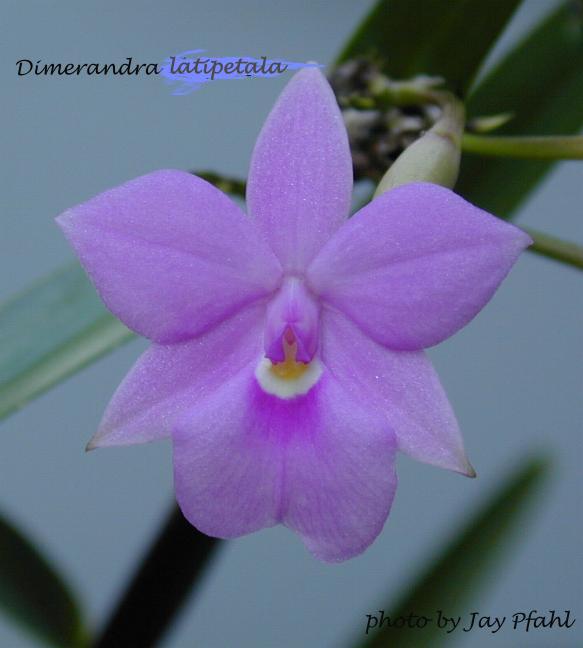
Pleurothallis quadrifida [La Llave & Lex]Lindley 1842
Plant and Flowers Photo courtesy of Jay Pfahl
18.00 Blooming Size Plants - all coming into spike now!
Flower Size 1/4 to 1/2" [7 to 9 mm]
This medium sized, hot to cool growing epiphytic or occasional lithophytic species is found in the West Indies, Mexico, Venezuela and Central America at altitudes up to 1800 meters in wet, exposed locations often in scrub forest and blooms mostly in the summer on an apical, erect, simple, to 15" [38 cm] long, simultaneously opening, many flowered, inflorescence subtended by a compressed sheath with the sweetly scented flowers held all to one side of the inflorescence which arises well above the leaves. Grow in a pot or mounted with semi-shade and give cool to hot temperatures with year round moisture and good air movement.
Synonyms *Dendrobium quadrifidum La Llave & Lex. 1825; Humboldtia incompta (Rchb. f.) Kuntze ?; Humboldtia longissima (Lindl.) Kuntze ?; Humboldtia nicaraguensis (Rchb. f.) Kuntze ?; Humboldtia quadrifida (Lex.) Kuntze; Humboltia incompta (Rchb. f.) Kuntze 1891; Humboltia longissima (Lindl.) Kuntze 1891; Humboltia nicaraguensis (Liebm.) Kuntze 1891; Humboltia quadrifida (Lex.) Kuntze 1891; Humboltia racemiflora (Lindl. ex Lodd.) Kuntze 1891; Physosiphon nicaraguensis Liebm. 1853; Pleurothallis ghiesbreghtiana A. Rich. & Galeotti 1845; Pleurothallis incompta Rchb. f. 1854; Pleurothallis longissima Lindl. 1859; Pleurothallis lyroglossa Schltr. 1910; Pleurothallis nicaraguensis (Liebm.) Rchb. f. 1861; Pleurothallis niederleinii Schltr. 1918; Pleurothallis racemiflora Lindley ex Hkr. 1824
--------------------------------------------------------------------------------------------------------------------------------------------------------------------------
Renanthera coccinea NO PHOTO AND Little info other than is is a hot to warm growing epiphyte from the Philippenes
26.00 NBS 4" clay pot 2' tall.
Renanthera Philippinense NO PHOTO Little info other than is is a hot to warm growing epiphyte from the Philippenes
26.00 NBS 4" clay pot 1' +.
!Schomburgkia fimbriata [Vell] Hoehne 1952
and EARLY
26.00 Close to Blooming size, this summer. 5" plastic pots
Common Name Glorious Schomburgkia
Flower Size 2 to 2 1/2" [5 to 6.25 cm]
Found in Venezuela, Guyana, Surinam, Colombia and Ecuador as a large, hot growing epiphyte with 2 leaves that is at elevations of 200 to 900 meters where it blooms in the fall and early winter on a to more than 4' [120 cm] long, apical, racemose, many flowered, clustered at the apex of the inflorescence with prominent bracts and has waxy, short-lived flowers arising on a mature psiuedobulb and is related to Schomburgkia crispa Lindley.
Synonyms Bletia crispina Rchb. f. 1862; Bletia gloriosa [Rchb.f] Rchb.f 1862; *Epidendrum fimbriatum Vell. non Hkr. 1827; Laelia gloriosa [Rchb.f] L.O.Wms. 1941; Schomburgkia amazonica Hoenhe Nomen Nudum ?; Schomburgkia crispa Lindley 1844; Schomburgkia gloriosa Rchb. f. 1860; Schomburgkia marginata Hkr. 1840; Schomburgkia marginata var immarginata Hkr. 1840
-------------------------------------------------------------------------------------------
Schomburgkia wallisii
15.00 NBS but all at least 8" tall with leaf
Common Name Lueddeman's Schomburgkia
This species is from Colombia and is a hot to warm growing epiphyte that is very similar to Schomburgkia lueddemaniana [the plant in the photo] and differs mainly in Geography and larger flowers.
!Tetramicra canaliculata [Aubl.] Urban 15.00 BS Mounted
Common Name Groove Leafed Orchid
Flower Size 1" [2.5 cm]
A warm growing, lithophytic or epiphytic Florida and Caribbean native found in lowland scrub at the base of rosemary bushes or on rocky hillsides among limestone in full sun with sticklike psuedobulbs, and blooms on a 2' [60 cm] long, slender, racemose, few flowered inflorescence that has several sheaths and ovate, acute bracts and the flowers opening in succession, all occuring in late spring and summer with slightly fragrant flowers.
Synonyms Bletia rigida Rchb.f 1861; Brassavola rigida Bold. ?; Cymbidium rigidum Willd. 1805; Epidendrum canaliculatum [Aubl.] Poiret 1810; Helliborne folis rigidis Plumier 1703; *Limodorum canaliculatum Aubl. 1775; Limodorum folis subulatus Wildn. 1758; Tetramicra rigida [Wilde] Lindley 1831;
--------------------------------------------------------------------------------------------
Tolumnia prionochilum - No photo - Blooming size plants in 2" clay pots - Small fan orchid with yellow and red flowers from Puerto Rico - some are in spike now.
15.00 Blooming Size Plants - some in spike now!
Tolumnia velutina (Lindl. ex Paxton) Braem 1986 15.00 NBS but Soon - Mounted
A Cuban hot to warm growing epiphytic fan shaped species that blooms on an erect, wiry, racemose to paniculate inflorescence with a few flowers.
Synonyms Oncidium variegatum var velutinum Greiseb. 1866; *Oncidium velutinum Lindl. ex Paxton 1851
!Tuberolabium kotoense Yamam. 1924 15.00 NBS But probably this summer - Mounted
Flower Size 1/2" [1.2 cm]
Found in the Taiwan and the Philippines on the trunks of ficus trees in montane forests at elevations around 300 meters as a hot to warm growing, miniature sympodial epiphyte that blooms on an 11" [to 25 cm] long, axillary, lateral, pendant, few to many [8 to 50] flowered inflorescence with the waxy, fleshy, flowers opening simultaneously and occuring in the winter. Grow this one mounted on tree fern or wood in semi-shade, high humidity and cool to hot temperatures.
Synonyms Saccolabium quisumbingii L. O. Williams 1938; Tuberolabium quisumbingii (L.O. Williams) Christenson 1992
---------------------------------------------------------------------------------------------------------
HYBRIDS All hybrids are $11 each 5 for $50
Brassia Rex 'Sakota' In 4" clay pot and is a seedling 3 years out of flask.
Brassia Datacosa 'Coo's Bay' AM/AOS In a 3" clay pot and is a seedling 3 years out of flask
Dcra Chantilly Lace to
to
to
to
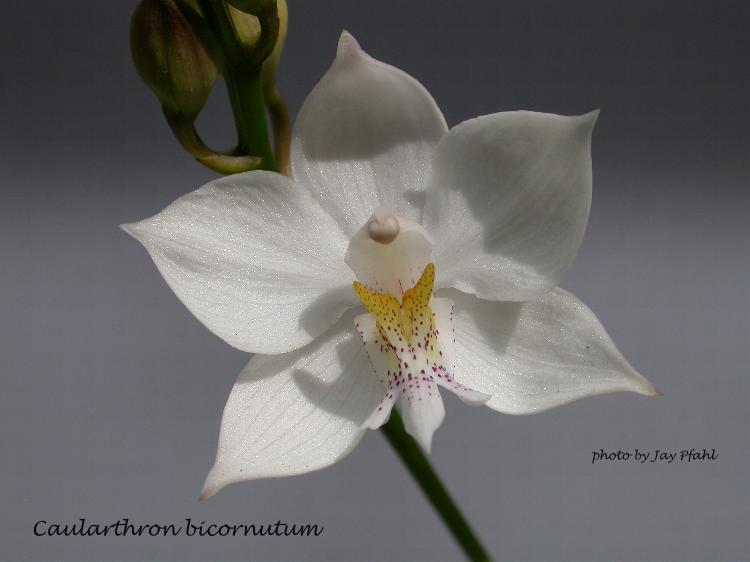
A cross between Cattleya El Dorado Splash [has Cattleya bicolor, intermedia, walkeriana, dolosa and loddigesii as parents] and Caularthroun bicornutum. Makes a nice pink and white Cattleya with an interesting shape.
LC Bethune "Mendenhall" 2" clay pots and is a seedling 2 years out of flask.
Don't know what to expect except that it should have some red in it.
BLC Hunting Island 'Hawaii' X BLC Toshie Aoki 'Pizzaz' In a 3" clay pot and is a seedling 3 years out of flask
LC Liptoni In a clay 3" pot and are 2 years out of flask
This is a primary hybrid between Cattleya labiata and Laelia anceps and are blooming out nicely
Potinara Beaufort Gold 'Lemon Drop X BLC Goldenzelle 'Sandra' AM/AOS In a 3" clay pot and is 3 years out of flask.
Expect large yellow flowers.


![Jumellea arachnantha [Rchb.f]Schlecter 1915](orphotdir/juellaarach.jpg)

![Laelia tenebrosa [Rolfe]Rolfe 1893](orphotdir/laeliatenebrosa.jpg)




![Aerangis articulata [Rchb.f]Schlecter 1914](orphotdir/aerapiculata.jpg)


![!Brassavola cucullata [L.] R.Br. 1813](orphotdir/brassavolacucullata.jpg)


![!Diaphananthe pellucida [Lindley]Schlecter 1914](orphotdir/diappellucida.jpg)


![Pleurothallis quadrifida [La Llave & Lex]Lindley 1842](orphotdir/pleurghiesbregh.jpg)


![!Schomburgkia fimbriata [Vell] Hoehne 1952](orphotdir/schombgloriosa.jpg)