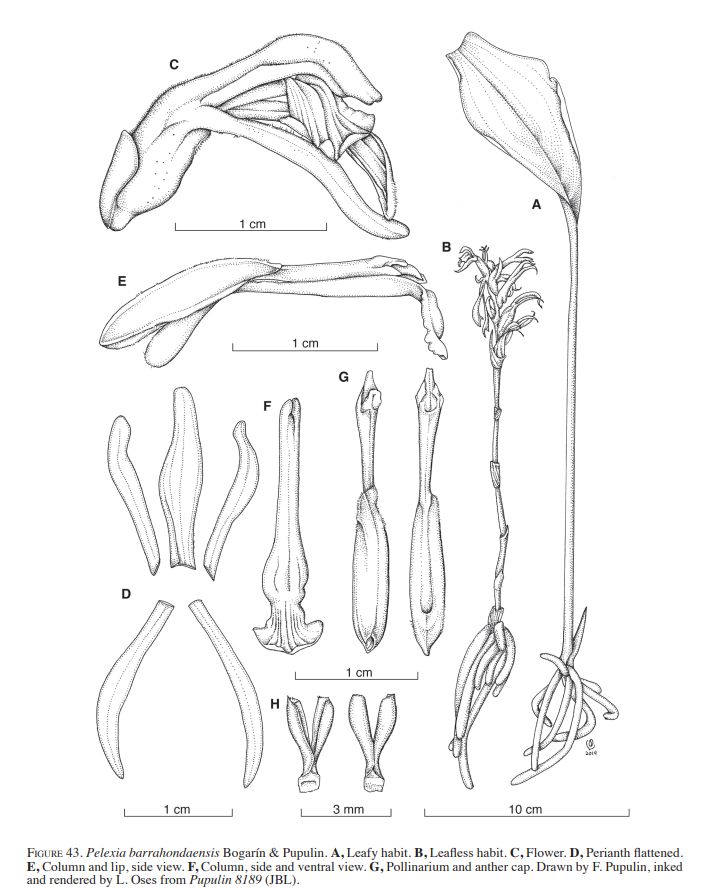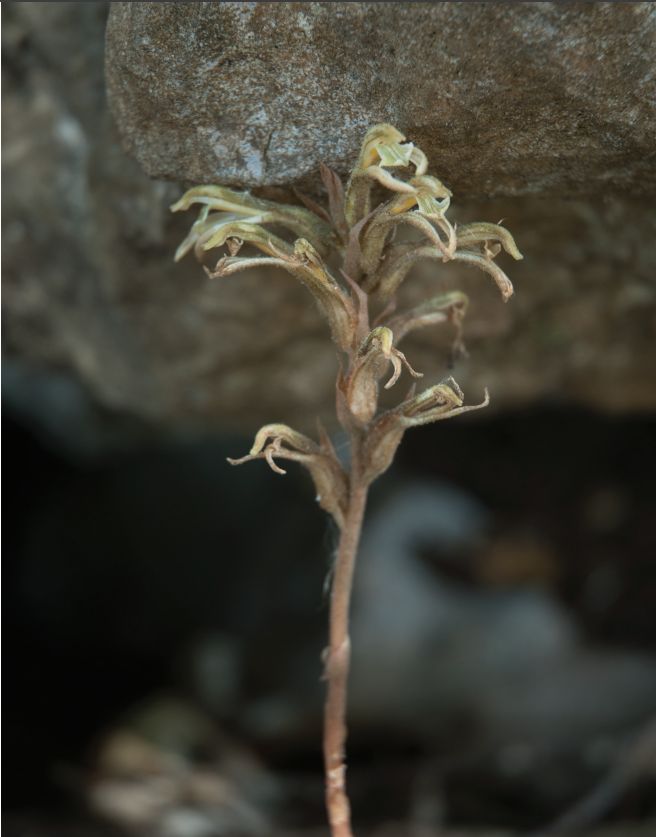
Pelexia barrahondaensis Bogarín & Pupulin 2021 SECTION Pelexia
Photo/TYPE Drawing by © Franco Pupulin and Harvard Pap. Bot. 26: 74 Bogarín & Pupulin 2021

 MID
MID 
Common Name The Barra Honda National Park Pelexia
Flower Size .8" [2 cm] long
Found in Guanacaste province of Costa Rica among rocks and in humus in premontane forests and "jaragua" pastures at elevations around 438 meters as a small sized, hot growing terretrial with a single, deciduous at flowering, elliptic-ovate, acute, conduplicate, conspiculously basally reddish-pinking, petioalte base leaf that blooms in the mid winter on an erect, terminal, , stout, peduncle 5.4 to 9.2" [13.5 to 23 cm] long, provided with about 7, tightly appressed, , tubular, acute, somewhat glandular sheathing bracts, pubescent or densely glandular, rachis 2.2 to 2.6" [5.5 to 6.5 cm] long, to 8 flowered inflorescence with ovate, acute to acuminate, basally glandular, shorter to as long as the ovary florlab racts and carrying densely glandular-pubescent in the outer part of the floral parts, resupinate, basally tubular, arcuate toward the apex, brown-green flowers with the lip white, the mesochile yellow, and the epichile white with green stripes.
"Similar to several other species in the allied genera but combined in a unique way. The long spur, almost equaling the length of the ovary, is similar to that of Pelexia funckiana, and Sarcoglottis schaffneri, two species restricted in distribution to northern Central America, as well as the mostly Andean Pelexia maculata. The general outline of the lip of P. barrahondaensis, which presents a distinct rectangular isthmus between hypochile and epichile, is rare in Pelexia, and to our knowledge, it can only be observed in Pelexia gutturosa, a species endemic to Honduras. However, the latter has very short leaves, a distinctly shorter spur, and an epichile with a strongly thickened keel along the midvein, while the epichile of P. barrahondaensis is ecallose. Also, the absence of callosities on the epichile and the apex of the hypochile is rarely found in Pelexia and probably limited to Pelexia funckiana, a species of broad distribution, and P. maculata. Pelexia funkiana, however, has a short spur (ca. 3 mm vs. ca. 10 mm), and in Costa Rica it is exclusively known from the wet forests of Caribbean Talamanca. From the wet Caribbean forest of the Tilarán Cordillera in northern Costa Rica is also known Pelexia congesta, which, however, has an acute spur and lip without an isthmus below the hypochile." Bogarín & Pupulin 2021
Synonyms
References W3 Tropicos, Kew Monocot list , IPNI ;
* Harvard Pap. Bot. 26: 73 Bogarín & Pupulin 2021
Harvard Pap. Bot. 26: 74 Bogarín & Pupulin 2021 Drawing fide
---------------------------------------------------------