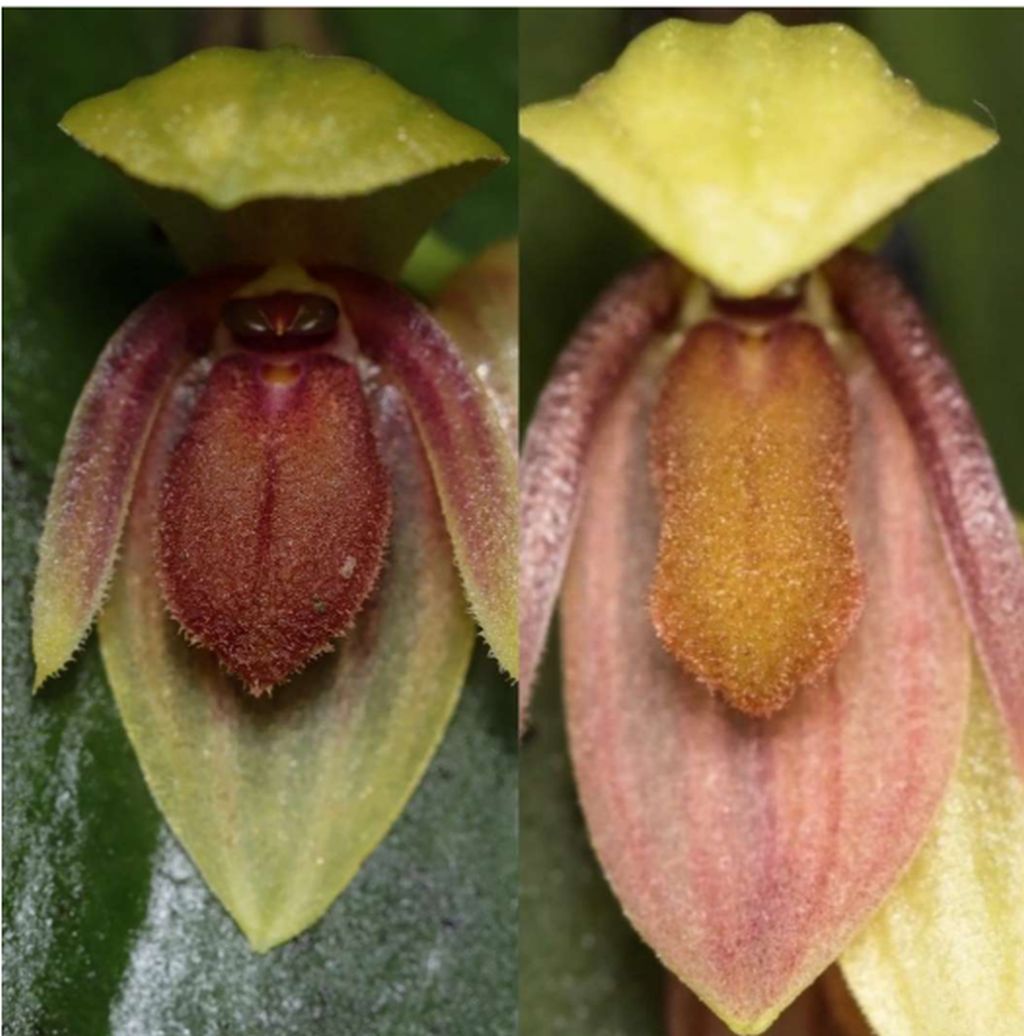
Pleurothallis brinkmaniana K.W. Holcomb 2024 SUBGENUS Pleurothallis SECTION Macrophyllae-Fasciculatae Lindl 1859
TYPE Photos by © K W Holcomb and Pleurothallidinae 3(3): 1 Holcomb 2024

Common Name Brinkman's Pleurothallis [American Named in honor of Becky Brinkman, manager of the Fuqua Orchid Center at the Atlanta Botanical Garden Current]
Flower Size
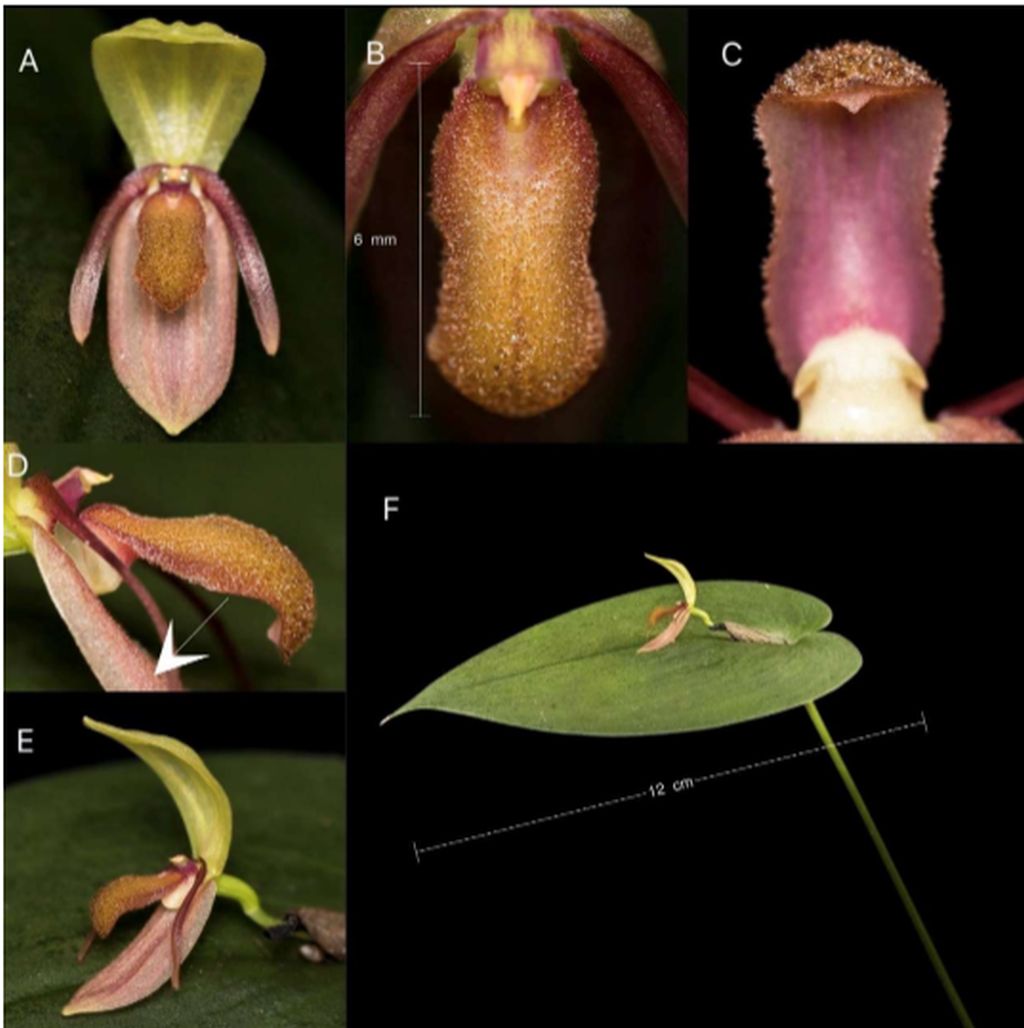
Found in Colombia without collection data as a small sized, caespitose epiphyte with very slender, suberect ramicauls enclosed by a thin tubular sheath below the middle and another at the base and carrying an apical, dark green with light green veins, coriaceous, cordate, acute, the sessile base cuneate into the base leaf that blooms on a 1.28" [3.2 cm] long, successively single, flowered inflorescence, borne from a reclining spathaceous bract at the base of the leaf and carrying a resupinate flower.
"Pleurothallis brinkmaniana belongs to the Pleurothallis adonis/Pleurothallis linguifera complex. Of the approximately eight species currently within this complex, P. brinkmaniana is most similar to Pleurothallis calogramma. However, P. brinkmaniana is easily recognized by its larger, narrower flowers with an extremely long, pandurate (violin-shaped) lip. The species within the P. adonis/linguifera complex exhibit a very interesting morphological characteristic associated with the lip. All species of SUBGENUS Pleurothallis SECTION Macrophyllae-Fasciculatae Lindl 1859 have a lip that is connected to the column foot by a hinge. However, the hinge has been rendered non-functional in most of the species in this section. Species in the Pleurothallis imperialis complex have evolved oversized petals that are positioned behind the lip which prevents the lip from moving . Species in the Pleurothallis titan and Pleurothallis cardiothallis complexes, have lips that rest firmly against the synsepal . Species in thePleurothallis bivalvis complex have evolved what is commonly referred to as a callus on the underside of the apex of the lip which functions as a “doorstopper” of sorts . By rendering the hinge non-functional, these species appear to be allowing access to pollinators of any size thereby increasing the chances of pollination. However, species in the P. adonis/linguifera complex all have large, convex lips with fully functional hinges, which are activated by the application of any significant weight (Fig. 5). When the hinge is activated, the lip drops, like a trap door away from the column, in effect, restricting access to only the tiniest of pollinators. Further research is warranted to understand this bizarre pollination strategy." K.W.Holcomb 2024
Synonyms
References W3 Tropicos, Kew Monocot list , IPNI ;
* Pleurothallidinae 3(3): 1 Holcomb 2024 Photos fide
--------------------------------------------------------------------------------------------------------------------------