
Alphabetical search! Use your back button to return.
| ||||
Genera or species names that are synonyms of current names are denoted with a ~.
I have decided to include synonyms in the alphabetical listings because I have found it frustrating to find that some growers do not stay currrent in their plant names and as such we the consumer end up buying a plant that we feel is an exotic different species only to find that it is a plant that we have had for years under the correct name. An example, Brassavola rhopalorrhachis Rchb.f is actually the common species Brassavola nodosa [L]Lindley.
Season Icons;
Spring =  Summer =
  Fall =
  Winter =
SIZE: Miniature - under 6" tall leaf and pseudobulb Small - under 12" tall leaf and pseudobulb Medium - under 24" tall Large - under 48" tall Giant - Over 48" tall
The basionym of a species is denoted with a "*". The basiosynonym is the very first name that a species had before it was changed to the current species name. If you have a name in parenthesis preceding another name, the name in parentheses is the basiosynonym. An example: ~*Ophrys bicolor Naegeli - See Ophrys apifera var. bicolor (Naegeli) Nelson: Ophyrs bicolor is the basiosynonym and in the current name the parentheses, (Naegeli), is the namer of the basiosynonym, while Nelson is the namer of the current species Ophyrs apifera var. bicolor.
! denotes the Type Species of the genus
If a genus is complete [all of the species are represented] it is preceded by a "`"


Taeniophyllum Blume 1825 A genus of leafless orchids. Around one hundred seventy to two hundred species in this genus are distributed from India, Sri Lanka, Japan, the Philippines to New Guinea, Australia, some Pacific Islands as far as Tahiti. New Guinea is considered to be the centre of distribution with some eighty species alone, some of which may prove to be conspecific. The species in the genus are small to very small leafless epiphytes with flattened green roots which contain chlorophyll and have taken over the photosynthetic role of the leaves. The leaves are reduced to minute, overlapping scales covering the stem apex. The flowers of the species are very short-lived, they are mostly greenish-white to yellow. Not easily detected in their natural habitat the species grow on tree trunks either near the forest floor or among the dense foliage of the smaller twigs. They are found from sea level to about 1000 m.
Narrative by Wolfgang Bandisch.
Common Name or Meaning refers to the tape-like roots
Type species = ! = Taeniophyllum glandulosum Blume 1825
~*Taeniophyllum exuperei Guillaumin 1957 - See Chiloschista exuperei (Guillaumin) Garay 1972
~Taeniophyllum obtusum Blume 1825 ~Taeniophyllum pusillum (Willd.) Seidenf. & Ormerod 1995 - See Chiloschista pusilla [Willd.] Schlechter 1919
Tainia Blume 1825 SUBFAMILY Epidendroideae, TRIBE Arethuseae, SUBTRIBE Bletiinae. There are 25 to 50 species in this deciduous terrestrial genus found from India through China and S.E. Asia and south to Indonesia. This genus has petiolate, plicate, and long inflorescence witha few to many well spaced, and often large flowers that has the lateral sepals fused to the coluymn foot [if present] to form a mentum, the lip is hinged to the column foot or if not hinged, spurred, entire or 3-lobed with keels on the upper surface. The column is slender, with or without a foot, the anther often with 2 horns and carrying 8 pollina.
Common Name or Meaning refers to tape, relation unclear
Type species = ! = Tainia speciosa Blume 1825
~Tainia angustifolia (Lindl.) Benth. & Hook.f. 1883 - See Tainia sutepensis (Rolfe ex Downie) Seidenf. & Smitin. 1959
~Tainia atropurpuea Ridl. 1896 - See Mischobulbum grandiflorum (Hook. f.) Schltr. 1911
~Tainia balansae Gagnep. 1932 - See Collabium chinensis (Rolfe) T. Tang & F.T. Wang 1977
~*Tainia cordifolia Hook. f. 1889 - See Mischobulbum cordifolium (Hook. f.) Schltr. 1911
~Tainia siamensis (Rolfe ex Downie) Seidenf. & Smitinand 1959 - See Tainia hookeriana King & Pantl. 1895
~Tainia stellata (Lindl.) Pfitzer 1888 - See Eria javanica (Sw.) Blume 1836
~Tainia wrayana [Hkr.f] J.J. Sm 1912 - See Mischobulbum grandiflorum (Hook. f.) Schltr. 1911
~Tainia unguiculata Hayata 1914 - See Acanthephippium striatum Lindley 1838
~`Talpinaria G. Karst. 1861 - See Pleurothallis R. Brown 1813 SUBFAMILY Epidendrodeae, TRIBE Epidendreae, SUBTRIBE Pleurothallidinae.
~Talpinaria bivalvis H. Karst. 1859 - See Pleurothallis talpinaria Rchb. f. 1886
~Talpinaria hitchcockii (Ames) Luer 2004 - See Pleurothallis hitchcockii Ames 1922
~Talpinaria punctulata (Rolfe) Luer 2004 - See Pleurothallis punctulata Rolfe 1888
~`Tankervillia Link 1829 - See Phaius Loureiro 1790 SUBFAMILY Epidendroideae, TRIBE Arethuseae, SUBTRIBE Bletinae
~Tankervillia cantoniensis Link 1829 - See Phaius tankervilliae [Ait.]Blume 1852
Tapeinoglossum Schlechter 1914 SUBFAMILY Epidendroideae, TRIBE Dendrobieae, SUBTRIBE Bulbophyllinae. A genus of only three species, all from New Guinea. : Epiphytic herbs from an altitude of 400 to 800 m with elongated rhizomes, small pseudo-bulbs from which arises a single leaf. The medium sized flowers are whitish with red veining and marking. The species occur in forests at altitudes between 400 to 800 metres, particularly in somewhat open forest near streams. In the Oro province towards the Bari region plants were observed to be fairly common on Leucaena trees in old coffee plantations.
Common Name or Meaning refers to the insignificant lip
Type species = ! = Bulbophyllum centrosemiflorum J.J. Smith 1912 = Tapeinoglossum centrosemiflorum (J.J. Smith) Schltr. 1913;
~Taurantha D.L.Jones & M.A.Clem. 2002 - See Pterostylis R. Brown 1810 SUBFAMILY Epidendroideae, TRIBE Diurideae, SUBTRIBE Pterostylidinae.
~Taurantha concinna ( R.Br. ) D.L.Jones & M.A.Clem. 2002 - See Pterostylis concinna R.Br. 1810
~`Taurostalix Rchb.f. 1852 - See Genyorchis Schltr. 1900 SUBFAMILY Epidendroideae, TRIBE Dendrobieae, SUBTRIBE Bulbophyllinae.
~Taurostalix herminiostachys Rchb.f 1852 - See Genyorchis pumila (Sw.) Schltr. 1901
Telipogon H.B.K. 1816 SUBFAMILY Epidendroideae, TRIBE Maxillarieae, SUBTRIBE Telipogoninae There are at least fifty species in this epiphytic, cloud forest, cool growing genus found from Costa Rica to Peru with the highest concentration in the high Andes of Colombia. They prove to be one of the most difficult orchids to maintain for any length of time. They are delicate, dwarf epiphytes without psuedobulbs, made up of clustered or distant, speedily deciduous, leaves ,which, from the axils arise a slender, few flowered inflorescence. They need damp cloud-forest conditions with deep shade, cool temperatures and ample air circulation. The cloud forest areas not only are damp but a permanent fog blankets the ground and light is rarely high, as it is difficult to even see 10' on a 'clear day'. They are one of the wettest orchids that you can grow and as such need to be misted constantly and watered regularly.
Common Name or Meaning refers to the hairs that cover the distal end of the column
Synonyms `Telopogon Spreng 1817; `Thelypogon Mutis ex Spreng 1826
Type species = ! = Telipogon angustifolius H.B.K. 1816 = Telipogon nervosus [L.]Druce 1916
~*Telipogon astroglossus Rchb.f 1854 - See Stellilabium astroglossum [Rchb.f] Schlechter 1914
~Telipogon bowmanii Rchb.f 1876 - See Telipogon vargasii C. Schweinf. 1946
~Telipogon bruchmuelleri Rchb. f. 1877 - See Telipogon latifolius HBK 1815
~Telipogon caucanus Schlechter 1920 - See Telipogon andicola Rchb.f 1855
~Telipogon dendriticus Rchb.f 1878 - See Telipogon andicola Rchb.f 1855
~Telipogon ecuadorensis Schlechter 1921 - See Telipogon andicola Rchb.f 1855
~Telipogon endresianus Kraenzl. 1919 - See Telipogon biolleyi Schltr. 1911
~Telipogon hercules Rchb. f. ex Kraenzl. 1919 - See Telipogon papilio Rchb. f. & Warsz. 1854
~Telipogon lehmannii Schltr. 1920 - See Telipogon latifolius HBK 1815
~*Telipogon minutiflorus Kraenzl. 1920 - See Stellilabium minutiflorum (Kraenzl.) Garay 1969
~Telipogon obovatus Lindl.1847 - See Telipogon tesselatus Lindl. 1844
~Telipogon pachyhybos Schltr. 1921 - See Telipogon tesselatus Lindl. 1844
~Telipogon polyrrhizus Rchb.f 1878 - See Telipogon andicola Rchb.f 1855
~Telipogon warscewiczii Rchb. f. 1858 - See Telipogon papilio Rchb. f. & Warsz. 1854
~`Telopogon Spreng 1817 - See Telipogon H.B.K. 1816 SUBFAMILY Epidendroideae, TRIBE Maxillarieae, SUBTRIBE Telipogoninae
~Tetrabaculum M.A.Clem. & D.L.Jones 2002 - See Dendrobium Sw. 1799 SUBFAMILY Epidendroideae, TRIBE Dendrobieae, SUBTRIBE Dendrobiinae.
~Tetrabaculum cacatua (M.A.Clem. & D.L.Jones) M.A.Clem. & D.L.Jones 2002 - See Dendrobium cacatua M.A.Clem. & D.L. Jones 1989
~Tetrabaculum capitisyork (M.A.Clem. & D.L.Jones) M.A.Clem. & D.L.Jones 2002 - See Dendrobium tetragonum Cunningham ex Lindley 1839
~Tetrabaculum melaleucaphilum (M.A.Clem. & D.L.Jones) M.A.Clem. & D.L.Jones 2002 - See Dendrobium melaleucophilum M. Clements & D. Jones 1989
~Tetragamestus Rchb. f. 1894 - See Scaphyglottis Poeppig & Endl. 1836 SUBFAMILY Epidendroideae, TRIBE Epidendreae, SUBTRIBE Laeliinae
~Tetragamestus gracilis Schltr.1918 - See Scaphyglottis prolifera Cogn. 1898
~Tetragamestus isochiloides Regel 1856 - See Scaphyglottis punctulata (Rchb. f.) C. Schweinf. 1955
Tetramicra Lindley 1831 SUBFAMILY Epidendroideae, TRIBE Epidendreae, SUBTRIBE Laeliinae. This genus has ten terrestrial or lithophytic warm growing species that all hail from the Caribbean growing in dry, rocky, limestone enviroments near sealevel to moderate elevations among cracks and crevasses exposed to the full sun. They have small or no psuedobulbs apaced far apart onlong branched rhizomes that bear fleshy often terete, rigid leaves, sometimes in loose fans that give rise to a wiry, tall inflorescence that have successive opening flowers that are well spaced on the stalk. They have 8 pollina, 4 large and four small I grow mine on a large hollowed-out tree fern slab that has finely chopped wood chips and charcoal just barely covering the roots, to accomodate the rangy growth habit of this attractive genus.
Common Name or Meaning refers to the stamina that is divided in to 4 parts
Type species = ! = Cymbidium rigidum Willd. 1805 = Tetramicra rigida [Wild.]Lindley 1831 = Tetramicra canaliculata Urban 1918
~Tetramicra bicolor [Lindley] Benth. 1883 - See Leptotes bicolor Lindley 1833
~Tetramicra minuta Rolfe 1889 - See Leptotes tenuis Rchb. f 1865
~Tetramicra pratensis [Rchb.f] Rolfe 1889 - See Tetramicra elegans [Hamilton] Cogn. 1910
~Tetramicra rigida [Wilde] Lindley 1839 - See T. canaliculata [Aublet] Urban
~Tetramicra schomburgkii [Rchb.f] Rolfe 1889 - See Tetramicra elegans [Hamilton] Cogn. 1910
~Tetramicra serrulata [Lindley]Nichols 1887- See Leptotes bicolor Lindley 1833
~Tetramicra subaequalis [Eggers] Rchb.f 1886 - See Tetramicra elegans [Hamilton] Cogn. 1910
Teuscheria Garay 1958 SUBFAMILY Epidendroideae, TRIBE Maxillarieae SUBTRIBE Bifrenarinae There are 6 species in this genus spread through central and South America from Costa Rica to Peru. It is allied to Bifrenaria and they are epiphytes with clustered ovoid pseudobulbs carryoing a single, apical, plicate, convolute, lanceolate to elliptic leafs that are surrounded basally by chartaceous sheaths and blooms on a basal, single flowered, erect or pendant inflorescence carrying a medium sized, resupinate or not flower with 4 hard, way pollina.
Common Name or Meaning Named for the Canadian Botanist Henry Teuscher
Type species = ! = Teuscheria cornucopia Garay 1958
Thecopus Seidenf. 1984 SUBFAMILY Epidendroideae, TRIBE Cymbidieae SUBTRIBE Thecostelinae There are two species in this Asian genus that is found
Common Name or Meaning Literally Box Foot - refers to the nectarium in the column foot
Type species ?
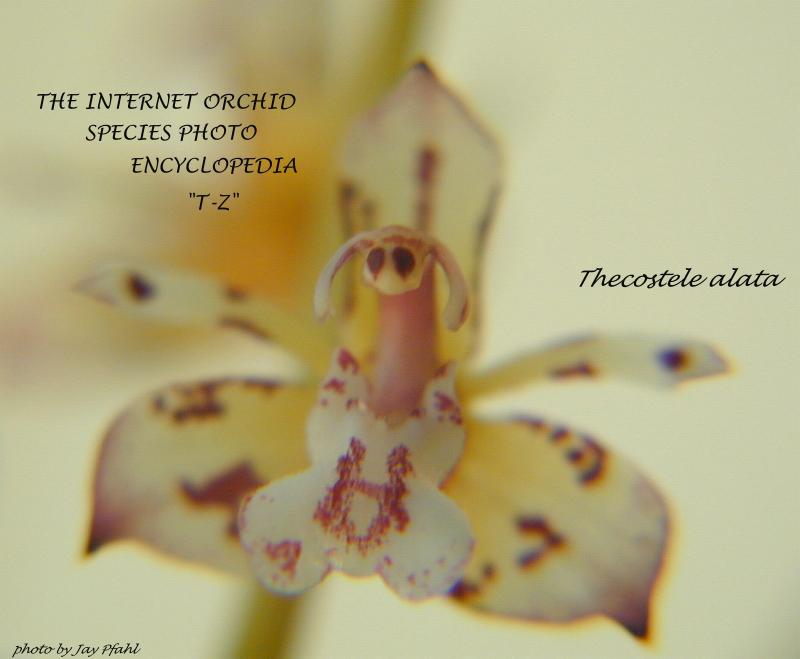
`Thecostele Rchb. f. 1857 SUBFAMILY Epidendroideae, TRIBE Cymbidieae SUBTRIBE Thecostelinae A monotypic genus widespread in SE Asia and surrounding Islands to the Philippines that is a small to medium sized epiphyte that can lose all it's leaves through the winter before blooming and new growth onset.
Common Name or Meaning refers to the box shaped coulumn
Type species = ! = Thecostele zollingeri Rchb. f. 1857 = Thecostele alata Parish & Rchb. f. 1874
~Thecostele elmeri (Ames) Ames 1952 - See Thecostele alata Parish & Rchb. f. 1874
~Thecostele maculosa Ridl. 1893 - See Thecostele alata Parish & Rchb. f. 1874
~Thecostele maingayi Hook.f. 1890 - See Thecopus maingayi (Hook.f.)Seidenf. 1983 publ. 1984
~Thecostele poilanei Gagnep. 1931 - See Thecostele alata Parish & Rchb. f. 1874
~Thecostele secunda Ridl. 1895 - See Thecopus secunda (Ridl.)Seidenf. 1984
~Thecostele wrayi (Hook. f.) Rolfe 1912 - See Thecostele alata Parish & Rchb. f. 1874
~Thecostele zollingeri Rchb. f. 1857 - See Thecostele alata Parish & Rchb. f. 1874
Thelasis Bl. 1825 SUBFAMILY Epidendroideae, TRIBE Podochileae, SUBTRIBE Thelasiinae. There are about 20 species in this tropical rainforest genus that now includes Oxyanthera. Found from India to China and south to Australia as fan-shaped epiphytes with pseudobulbs that have barely open flowers with the lip attached to the base of the footless column.
Common Name or Meaning Named erroneously as a sucking parasite
Type species = ! = ?
~Thelasis carinata f. semipelorica J.J.Sm. 1929 - See Thelasis carinata Blume 1825
~Thelasis elata Hook. f. 1890 - See Thelasis carinata Rchb. f. 1857
~Thelychiton Endl. 1833- See Dendrobium Sw. 1799 SUBFAMILY Epidendroideae, TRIBE Dendrobieae, SUBTRIBE Dendrobiinae.
~Thelychiton adae (F.M.Bailey) M.A.Clem. & D.L.Jones 2002 - See Dendrobium adae F.M. Bailey 1884
~Thelychiton capricornicus (Clemesha) M.A.Clem. & D.L.Jones 2002 - See
~Thelychiton comptonii (Rendle) M.A.Clem. & D.L.Jones 2002 - See Dendrobium comptonii Rendle 1921
~Thelychiton curvicaulis (F.M.Bailey) M.A.Clem. & D.L.Jones, 2002 - See Dendrobium curvicaule [F.M.Bailey]M. Clements & D.L. Jones 1989
~Thelychiton × delicatus (F.M.Bailey) M.A.Clem. & D.L.Jones, 2002 - See Dendrobium X delicatum (F.M. Bailey) F.M. Bailey 1902
~Thelychiton falcorostrus (W.Fitzg.) M.A.Clem. & D.L.Jones 2002 - See Dendrobium falcorostrum Fitzgerald 1876
~Thelychiton fleckeri (Rupp & C.T.White) M.A.Clem. & D.L.Jones 2002 - See Dendrobium fleckeri Rupp & C.T. White 1937
~Thelychiton gracilicaulis (F.Muell.) M.A.Clem. & D.L.Jones 2002 - See Dendrobium gracilicaule F. Muell. 1894
~Thelychiton jonesii ( Rendle ) M.A.Clem. & D.L.Jones 2002 - See Dendrobium jonesii Rendle 1901
~Thelychiton jonesii subsp. bancroftianus (Rchb.f.) M.A.Clem. & D.L.Jones 2002 - See Dendrobium jonesii Rendle 1901
~Thelychiton jonesii subsp. blackburnii (Nicholls) M.A.Clem. & D.L.Jones 2002 - See Dendrobium jonesii Rendle 1901
~Thelychiton kingianus (Bidwill ex Lindl.) M.A.Clem. & D.L.Jones 2002 - See Dendrobium kingianum Bidwill ex Lindley 1844
~Thelychiton moorei (F.Muell.) M.A.Clem. & D.L.Jones 2002 - See Dendrobium moorei F. Muell. 1869
~Thelychiton pedunculatus (Clemesha) M.A.Clem. & D.L.Jones 2002 - See Dendrobium pedunculatum (Clemesha) D.L. Jones & M.A. Clem. 1989
~Thelychiton rex (M.A.Clem. & D.L.Jones) M.A.Clem. & D.L.Jones, 2002 - See Dendrobium rex M.A. Clem. & D.L. Jones 1989
~Thelychiton speciosus (Sm.) M.A.Clem. & D.L.Jones 2002 - See Dendrobium speciosum J. E Smith 1805
~Thelychiton tarberi (M.A.Clem. & D.L.Jones) M.A.Clem. & D.L.Jones 2002 - See Dendrobium tarberi M. Clements & D. Jones 1989
Thelymitra J.&G.Forst 1775 SUBFAMILY Orchidoideae, TRIBE Diurideae, SUBTRIBE Diuridinae There are 45 species in this genus that as a whole are from Australia, 2 from New Zealand and 1 is from the Philippines , New Guinea and Java. They are terrestrial colony forming herbs with subterranean tubers and are commonly called 'Sun Orchids'. Many of the species in this genus are blue which is one of the rarer colors in the orchids.
Common Name or Meaning refers to the fused stamen
Synonyms Macdonaldia Gunn. ex Lindley 1840
Type species = ! = Thelymitra longifolia J.& G. Forst. 1775 = Thelymitra nuda R. Br. 1810
~Thelymitra angustifolia Hook. f. 1858 - See Thelymitra aristata Lindl. 1830
~Thelymitra carnea var. rubra ( Fitzg. ) J.Z.Weber & R.J.Bates 1978 - See Thelymitra rubra Fitzg. 1867
Thelymitra grandis F. Muell. ex Benth. 1873 - See Thelymitra aristata Lindl. 1830
~Thelymitra ixioides Sw. 1800 - See Thelymitra ixioides Smith ex Sw. 1805
~Thelymitra ixioides var. carnea Guilf. 1911 - See Thelymitra ixioides Smith ex Sw. 1805
~Thelymitra longifolia J. & G. Forst. 1775 - See Thelymitra nuda R. Br. 1810
~*Thelymitra variegata var. apiculata A.S. George 1984 - See Thelymitra apiculata (A.S. George) M.A. Clem. & D.L. Jones 1989
~`Thelypogon Spreng 1826 - See Telipogon H.B.K. 1816 SUBFAMILY Epidendroideae, TRIBE Maxillarieae, SUBTRIBE Telipogoninae
~Theodorea Barb. Rod. 1877 - See Rodrigueziella SUBFAMILY Epidendroideae, TRIBE Maxillareae SUBTRIBE Oncidiinae
~*Theodorea gomezioides Barb.Rodr. 1877 - See Rodrigueziella gomezoides (Barb. Rodr.) Berman 1973
~Theodorea paniculata Brade 1949 - Rodrigueziella gomezoides (Barb. Rodr.) Berman 1973
~`Thicuania Raf. 1836 [1838] - See Dendrobium Sw. 1799 SUBFAMILY Epidendroideae, TRIBE Dendrobieae, SUBTRIBE Dendrobiinae.
~Thicuania moschata (Sw.) Raf. 1836 - See Dendrobium moschatum Sw. 1805
~`Thiebautia Colla 1824 - See Bletia Ruiz & Pavon 1794 SUBFAMILY Epidendroideae, TRIBE Arethuseae, SUBTRIBE Bletinae.
~Thiebautia nervosa Colla 1824 - See Bletia florida (Salisb.) R.Br. 1813
~`Thorvaldsenia Leibm. ex Hartman 1844 - See Chysis Lindley SUBFAMILY Epidendroideae, TRIBE Arethuseae, SUBTRIBE Bletiinae
~Thorvaldsenia speciosa Liebm. 1844 - See Chysis bractescens Lindley 1840
Thrixspermum Lour. 1790 SUBFAMILY Epidendroideae, TRIBE Vandeae, SUBTRIBE Aeridinae. There are about sixty species in this monopodial, epiphytic, wide ranging genus that is found from Ceylon to Samoa, but with the major concentration in Malaysia, the Philippines and Indonesia. There are 2 sections of this genus and it is dependant on the form of the inflorescence. Group #1 is the Orsidice, which has the flowers side by side, and the #2 group, Dendrocolla, has flowers that face all directions. This genus is best grown as any Vanda might, basically warm growing, high light and ample water and fertilizer year round.
Common Name or Meaning refers to the hair-like seeds
Synonyms Dendrocolla Blume 1825; `Orsidice Rchb.f 1854; Ridleya 1900
Type species = ! = Thrixspermum centipeda Lour. 1790
~Thrixspermum appendiculatum (Blume) Kuntze 1891 - See Stereochilus hirtus Lindl. 1859
~Thrixspermum auriferum (Lindl.) Rchb. f. 1830 - See Thrixspermum centipeda Lour. 1790
~Thrixspermum australe (Lindl.) Rchb.f. . 1868 - See Sarcochilus australis (Lindl.) Rchb.f. 1863
~Thrixspermum beccarii Rchb. f. 1881 - See Rhinerrhiza moorei (Rchb. f.) M.A. Clem., B.J. Wallace & D.L. Jones 1989
~Thrixspermum brachyglottis (Hook.f.) Kuntze 1891 - See Tuberolabium rhopalorrhachis (Rchb. f.) J.J. Wood 1990
~Thrixspermum brachyglottis (Hook.f.) Ridl. 1907 - See Tuberolabium rhopalorrhachis (Rchb. f.) J.J. Wood 1990
~Thrixspermum ceciliae Rchb.f 1871- See Sarcochilus ceciliae FvM 1865
~Thrixspermum falcatum [R.Br.]Rchb.f 1868- See Sarcochilus falcatus R. Br. 1810
~Thrixspermum hainanense (Rolfe) Schltr. 1911 - See Thrixspermum centipeda Lour. 1790
~Thrixspermum hillii Rchb.f 1871- See Sarcochilus hillii [FvM]FvM 1861
~Thrixspermum hirtulum (Hook.f.) Kuntze 1891 - See Stereochilus hirtus Lindl. 1859
~Thrixspermum kusukusense (Hayata) Schltr. 1919 - See Thrixspermum merguense (Hook. f.) Kuntze 1891
~Thrixspermum lilacinum (Griff.) Rchb. f. 1868 - See Thrixspermum amplexicaule (Rchb. f.) Rchb. f. 1868
~*Thrixspermum lunifera Rchb.f 1868 - See Chiloschlsta lunifera [Rchb.f]J.J.Smith 1905
~Thrixspermum merguense (Hook. f.) Seidenf. & Smitin. 1963 - See Thrixspermum merguense (Hook. f.) Kuntze 1891
~*Thrixspermum moorei Rchb. f. 1880 - See Rhinerrhiza moorei (Rchb. f.) M.A. Clem., B.J. Wallace & D.L. Jones 1989
~Thrixspermum notabile (Hook. f.) Kuntze 1891 - See Thrixspermum acuminatissimum (Rchb. f.) Rchb.f. 1868
~Thrixspermum pallidum (Blume) Rchb.f. 1868 - See Pteroceras pallidum (Bl.) Holtt. 1960
~Thrixspermum pictum (Lindl.) Rchb.f. 1868 - See Sarcochilus australis (Lindl.) Rchb.f. 1863
~Thrixspermum teysmannii (Miq.) Rchb.f.b 1868 - See Pteroceras teysmannii (Miq.) Holttum 1960
~Thrixspermum tridentatum (Lindl.) Rchb. f. 1868 - See Plectorrhiza tridentata [Lindley]Dockrill 1967
~Thrixspermum unguiculatum (Lindl.) Rchb. f. 1868 - See Pteroceras pallidum (Bl.) Holtt. 1960
~Thrixspermum usneoides (Rchb. f.) Rchb. f. 1868 - See Chiloschista usneoides (Rchb. f.) Lindl. 1832
Thunia Rchb.f 1852 SUBFAMILY Epidendroideae, TRIBE Coelogyneae, SUBTRIBE Thuniinae. There are less than 6 species in this terrestrial genus without psuedobulbs found in India, China and SE Asia and is similar to Phaius yet differs in it's lack of psuedobulbs, slightly nodose stems which are covered by leafy sheaths below and gradually passing to true leaves above and its terminal inflorescence with persistent bracts.
Common Name or Meaning Named for the orchid enthusiast Count Thun-Hohenstein of Germany
Synonyms `Phajus Lindley 1831
Type species = ! = Thunia alba [Lindl.] Rchb.f 1852
~Thunia alba var. bracteata (Roxb.) N.Pearce & P.J.Cribb 2001 - See Thunia bracteata (Roxb.) Schltr. 1919
`Thynninorchis D.L.Jones & M.A.Clem. 2002 SUBFAMILY Orchidoideae, TRIBE Diurideae, SUBTRIBE Drakaeinae There are two species in this Australian terrestrial genus pollinated by the Thynoid wasp.
Common Name or Meaning Pollinated by the Thynoid wasp
Type species = ! =
~Thynninorchis nothofagicola (D.L.Jones) D.L.Jones & M.A.Clem. 2002 - See Thynninorchis huntiana ( F.Muell. ) D.L.Jones & M.A.Clem. 2002
Ticoglossum Lucas Rodr. ex Halb. 1983 SUBFAMILY Epidendroideae, TRIBE Maxillarieae SUBTRIBE Oncidiinae There are 2 species in this genus separated from Oncidium both occuring in Costa Rica.
Common Name or Meaning Tico refers to Costa Rican
Type species = ! = Ticoglossum krameri (Rchb. f.) Lucas Rodr. ex Halb.
~`Tinea Biv. 1833 - See Neotinea Rchb.f. 1852 SUBFAMILY Orchidoideae, TRIBE Orchideae SUBTRIBE Orchidinae
~Tinea cylindrica Biv. 1833 - See Neotinea maculata (Desfontaines) Stearn 1975
~Tinea intacta (Link) Boiss. 1882 - See Neotinea maculata (Desfontaines) Stearn 1975
~Tinea maculata (Desf.) Vis. 1851 - See Neotinea maculata (Desfontaines) Stearn 1975
Tipularia Nutt. 1818 SUBFAMILY Orchidoideae, TRIBE Calypsoeae, . This is a small genus of 3 species of which one is found in the USA. They are characterized by a series of connected underground tubers giving rise to a leaf in the fall and a flowering stem in the spring with a long slender spur.
Common Name or Meaning refers to the flower being spider-like
Type species = ! = Tipularia discolor (Pursh) Nutt. 1818
~Tipularia unifolia (Muhl.) Britton, Sterns & Poggenb ?- See Tipularia discolor (Pursh) Nutt. 1818
`~Todaroa A. Rich. & Galeotti 1843 SUBFAMILY Epidendroideae, TRIBE Vandeae, SUBTRIBE Aeridinae.
~Todaroa micrantha A. Rich. & Galeotti 1845 - See Campylocentrum micranthum (Lindl.) Rolfe 1903
Tolumnia Raf. 1837 SUBFAMILY Epidendroideae, TRIBE Maxillarieae SUBTRIBE Oncidiinae
Common Name or Meaning Named for Tolumnius a character in Virgil's Aeneas, relation unclear
Type species = ! = Tolumnia pulchella [Hook] Raf. 1836
~Tolumnia apiculata ( Moir ) Braem 1986 - See Oncidium luridum Lindl. 1823
~Tolumnia berenyce ( Rchb.f. ) Braem 1986 - See Oncidium luridum Lindl. 1823
~Tolumnia borinquensis Salueda & Ragan 1966 - See Tolumnia variegata (Sw.) Braem 1986
~Tolumnia caymanensis [Moir] Braeme 1986 - See Tolumnia variegata (Sw.) Braem 1986
~Tolumnia concava ( Moir ) Braem 1986 - See Tolumnia pulchella [Hook.] Raf. 1836
~Tolumnia cuneilabia ( Moir ) Braem 1986 - See Oncidium luridum Lindl. 1823
~Tolumnia henekenii (R.H. Schomb. ex Lindl.) Nir 1994 - See Hispaniella henekenii (Schomb ex Lindley) Braem 1980
~Tolumnia lemoniana ssp lemoniana Braem 1990 - See Tolumnia guianensis (Aubl.) Braem 1986
~Tolumnia pusilla (L.) Hoehne 1949 - See Psygmorchis pusilla (L.) Dodson & Dressler 1972
`Tomzanonia Nir 1997 SUBFAMILY Epidendroideae, TRIBE Epidendreae, SUBTRIBE Laeliinae. This is a monotypic epiphyte from Hispanola where it has distichous, conduplicate, serrate leaves, a terminal single flowered inflorescence, and a resupinate flower with 8 pollina.
Type species = ! = Tomzanonia filicina [Dod]Nir 1997
~Trachelosiphon Schlecter 1920 - See Eurystyles Wawra 1863 SUBFAMILY Spiranthoideae TRIBE Cranichideae, SUBTRIBE Spiranthinae
~Trachelosiphon colombianum Schltr. 1920 - See Eurystyles cotyledon Wawra 1863
~Trachelosiphon paranaense Schltr. 1920 - See Eurystyles cotyledon Wawra 1863
Trachoma Garay 1972 SUBFAMILY Epidendroideae, TRIBE Vandeae, SUBTRIBE Aeridinae.
Common Name or Meaning referes to the floral bracts near the flowers
Type species = ?
~Trachoma rhopalorhachis (Rchb. f.) Garay 1972 - See Tuberolabium rhopalorrhachis (Rchb. f.) J.J. Wood 1990
~Trachyrhizum (Schltr.) Brieger 1981 - See Dendrobium Sw. 1799 SUBFAMILY Epidendroideae, TRIBE Dendrobieae, SUBTRIBE Dendrobiinae.
~Trachyrhizum agrostophyllum (F. Muell.) Rauschert 1983 - See Dendrobium agrostophylum F. Mueller 1872
~Trachyrhizum prostheciglossum (Schltr.) Brieger 1981 - See Dendrobium prostheciglossum Schltr. 1912
~Trachyrhizum villosipes (J.J.Sm.) Rauschert 1983 - See Dendrobium prostheciglossum Schltr. 1912
Traunsteinera Rchb. 1842 SUBFAMILY Orchidoideae, TRIBE Orchideae, SUBTRIBE Orchidinae.
Common Name or Meaning Named for Josef Traunsteiner an Austrian amatuer botanist
Type species = ! = Traunsteinera globosa (Linne) Rchb. 1842
~Traunsteinera globosa f. major (Schur) Beldie 1972 - See Traunsteinera globosa (Linne) Rchb. 1842
Trevoria F. C. Lehm.1897 SUBFAMILY Epidendroideae, TRIBE Gongoreae, SUBTRIBE Stanhopeinae. There are 5 seldom seen species in this rare, epiphytic, cool growing genus found from Nicaragua to Bolivia. They are characterized by having globose, ovoid or elongate pseudobulbs with one or twp terminal, plicate leaves, a pendant, racemose, few to many flowered inflorescence which has nonresupinate flowers with the lateral sepals free or basallly connate and wider than the petals, a fleshy lip that is firmly united to the base of the column and a fleshy callus on the concave hypochile, a flseshy mesochile and an extended epichile. There are two pollina attached to a long stipe in turn attached to a viscidium.
Common Name or Meaning Named for Sir Trevor Lawrence, former President of RHS
Synonyms Endresiella Schlecter 1921
Type species = ! = Trevoria chloris Lehmann 1897
~Triaristella (Rchb. f.) Brieger 1978 ex Luer - See Trisetella Luer 1980 SUBFAMILY Epidendroideae, TRIBE Epidendreae, SUBTRIBE Pleurothallidinae.
~Triaristella didyma [Luer] Luer 1978 - See Trisetella didyma (Luer) Luer 1980
~Triaristella dressleri (Luer) Luer 1978 - See Trisetella dressleri (Luer) Luer 1980
~Triaristella gemmata (Rchb. f.) Luer 1978 - See Trisetella gemmata (Rchb. f.) Luer 1980
~Triaristella huebneri (Schltr.) Luer 1978 - See Trisetella huebneri (Schltr.) Luer 1980
~Triaristella pantex (Luer) Luer 1978 - See Trisetella pantex (Luer) Luer 1980
~Triaristella reichenbachii Brieger 1976 - See Trisetella triaristella ( Rchb.f. ) Luer 1980
~Triaristella trichaete (Rchb. f.) Luer 1978 - See Trisetella triglochin (Rchb. f.) Luer 1980
~Triaristella tridactylites (Rchb. f.) Luer 1978 - See Trisetella triglochin (Rchb. f.) Luer 1980
~Triaristella triglochin (Rchb. f.) Luer 1978 - See Trisetella triglochin (Rchb. f.) Luer 1980
~Triaristella vittata (Luer) Luer 1978 - See Trisetella vittata (Luer) Luer 1980
~Triaristellina Rauschert - See Trisetella Luer 1980 SUBFAMILY Epidendroideae, TRIBE Epidendreae, SUBTRIBE Pleurothallidinae.
~Triaristellina didyma [Luer] Rauschert 1983 - See Trisetella didyma (Luer) Luer 1980
~Triaristellina dressleri (Luer) Rauschert 1983 - See Trisetella dressleri (Luer) Luer 1980
~Triaristellina gemmata (Rchb. f.) Rauschert 1983 - See Trisetella gemmata (Rchb. f.) Luer 1980
~Triaristellina huebneri (Schltr.) Rauschert - See Trisetella huebneri (Schltr.) Luer 1980
~Triaristellina pantex (Luer) Rauschert 1983 - See Trisetella pantex (Luer) Luer 1980
~Triaristellina triaristella ( Rchb.f. ) Rauschert 1983 - See Trisetella triaristella ( Rchb.f. ) Luer 1980
~Triaristellina trichaete (Rchb. f.) Rauschert - See Trisetella triglochin (Rchb. f.) Luer 1980
~Triaristellina tridactylites (Rchb. f.) Rauschert - See Trisetella triglochin (Rchb. f.) Luer 1980
~Triaristellina triglochin (Rchb. f.) Rauschert - See Trisetella triglochin (Rchb. f.) Luer 1980
~Triaristellina vittata (Luer) Rauschert 1983 - See Trisetella vittata (Luer) Luer 1980
Trias Lindley 1830SUBFAMILY Epidendroideae, TRIBE Epidendreae SUBTRIBE Bulbophyllinae. Similar to the genus Bulbophyllum but with floral differences, this genus has 13 rarely seen epiphytic species, that have similar cultural requirements to Bulbophyllum. The flowers in this genus always have a triangular appearance and are on a short basal inflorescence. The distiction between this genus and Bulbophyllum is a two-chambered anther with a forward projecting prolongation that can be cylindric or divided into two to three parts
Common Name or Meaning refers to the triangular flower
Synonyms Drymoda Lindl. 1838; Phyllorchis Thou. 1822
Type species = ! = Trias oblonga Lindley 1830
~Trias ovata Lindl. 1830 - See Trias oblonga Lindley 1829
~Trias rolfei Stapf 1928 - See Trias roseum [Ridley] Seidenfadden 1976
~Trias rolfei Stapf 1928 - See Trias roseum [Ridley] Seidenfadden 1976
~Trias vitrina Rolfe 1895 - See Trias nasuta [Rchb.f]Stapf. 1928
~Tribrachia Lindley 1824 - See Bulbophyllum Thouars 1822 SUBFAMILY Epidendroideae, TRIBE Dendrobieae, SUBTRIBE Bulbophyllinae.
~Tribrachia hirta Lindl. 1821 - See Bulbophyllum hirtum [Sm.]Lindl. 1828
~Tribrachia odoratissima (Sm.) Lindl. 1821 - See Bulbophyllum odoratissimum (Sm.) Lindl. 1830
~Tribrachia purpurea [D.Don] Lindl. 1826 - See Bulbophyllum careyanum (Hook.) Spreng. 1826
~Tribrachia racemosa Lindl. ex Schltr. - See Liparis nervosa (Thunb.) Lindl. 1830
~Tribrachia racemosa (Sm.) Lindl. 1826 - See Bulbophyllum reptans (Lindl.) Lindl 1829
~Tribrachia recurva (Lindl.) Lindl. 1826 - See Genyorchis pumila (Sw.) Schltr. 1901
~Tribrachia reptans Lindl. - See Bulbophyllum reptans (Lindl.) Lindl 1829
~`Tribulago Luer 2004 - See Pleurothallis R. Brown 1813 SUBFAMILY Epidendrodeae, TRIBE Epidendreae, SUBTRIBE Pleurothallidinae
~Tribulago tribuloides (Sw.) Luer 2004 - See Pleurothallis tribuloides (Sw.) Lindl. 1830
Trichocentrum Poeppig & Endl. 1836 SUBFAMILY Epidendroideae, TRIBE Maxillareae SUBTRIBE Oncidiinae. Eighteen epiphytic species ranging from Mexico to Southern Brazil, with the majority in the later country, make up this showy genus. It's major distinction from other Oncidinae is the floral spur which is part of the lip and not an extension of the column as in other Oncidinae. They are characterized by being small epiphytes with small pseudobulbs carrying an apical leaf, The pendant inflorescence forms basally and is a single to few flowered raceme. The medium sized flowers have similar petals and sepals, a lip, mostly long or short spurred and the blade with variously shaped calli. The short column has a pair of apical wings, often a papillose anther, with two stpitate pollina. The flowers are large and showy for the size of this compact growing plant which is best mounted on cork or treefern and given ample light, high humidity and ample water and fertilizer while in growth and a little less after maturation. They are hot to cool growing plants that appreciate good air circulation.
Common Name or Meaning refers to the hair-like spur
Synonyms Acoidium Lindley 1837
Type species = ! = Trichocentrum pulchrum Poepp. & Endl. 1836
~*Trichocentrum alatum Rolfe 1898 - See Plectrophora alata (Rolfe) Garay 1967
~Trichocentrum albiflorum Rolfe 1893 - See Trichocentrum candidum Lindl. 1843
~Trichocentrum albopurpureum Linden & Rchb.f 1866 - See Trichocentrum albococcineum Linden 1865
~Trichocentrum albo-violaceum Rchb.f ex Schlecter 1927 - See Trichocentrum albo-coccineum Linden 1865
~Trichocentrum amazonicum Barb. Rodr. 1877 - See Trichocentrum albococcineum Linden 1865
~Trichocentrum ascendens (Lindl.) M.W.Chase & N.H.Williams 2001 - See Oncidium ascendens Lindley 1842
~Trichocentrum atropurpureum Linden ex Regal 1866 - See Trichocentrum albo-coccineum Linden 1865
~Trichocentrum atro-violaceum Rchb.f ex Schlecter ? - See Trichocentrum albo-coccineum Linden 1865
~Trichocentrum bicallosum (Lindl.) M.W.Chase & N.H.Williams 2001; 1842 - See Oncidium bicallosum Lindl. 1842
~Trichocentrum carthagenense (Jacq.) M.W.Chase & N.H.Williams 2001 - See Oncidium carthagenense [Jacq]Swartz 1800
~Trichocentrum cavendishianum (Bateman) M.W.Chase & N.H.Williams 2001 - See Oncidium cavendishianum Bateman 1837
~Trichocentrum cebolleta (Jacq.) M.W.Chase & N.H.Williams 2001 - See Oncidium cebolleta (Jacq.) Sw. 1800
~Trichocentrum cornucopiae Linden & Rchb. f. 1866 - See Trichocentrum fuscum Lindl. 1837
~Trichocentrum cosymbephorum (C.Morren) R.Jiménez & Carnevali . 2003 - See Oncidium cosymbephorum Morren 1849
~Trichocentrum flavovirens (L.O.Williams) M.W.Chase & N.H.Williams 2001 - See Oncidium flavovirens L.O. Williams 1942
~Trichocentrum funale (Sw.) Lindl. 1837 - See Dendrophylax funalis [Sw.]Fawcett 1889
~Trichocentrum haematochilum (Lindl. & Paxton) M.W.Chase & N.H.Williams 2001 - See Oncidium x haematochilum Lindl. & Paxton 1850-1
~Trichocentrum hartii Rolfe 1894 - See Trichocentrum fuscum Lindl. 1837
~Trichocentrum jonesianum (Rchb.f.) M.W.Chase & N.H.Williams 2001 - See Oncidium jonesianum Rchb.f 1883
~Trichocentrum lanceanum (Lindl.) M.W.Chase & N.H.Williams 2001 - See Oncidium lanceanum Lindley 1842
~Trichocentrum lindenii (Brongn.) M.W.Chase & N.H.Williams 2001 - See Oncidium lindenii Brogn. 1842
~Trichocentrum luridum (Lindl.) M.W.Chase & N.H.Williams 2001 - See Oncidium luridum Lindl. 1823
~Trichocentrum maculatum ( Aubl. ) M.W.Chase & N.H.Williams 2001 - See Oncidium luridum Lindl. 1823
~Trichocentrum maculatum Lindl. 1846 - See Trichocentrum pulchrum Poepp. & Endl. 1836
~Trichocentrum margalefii (Hágsater) M.W.Chase & N.H.Williams 2001 - See Oncidium margalefii Hágsater 1974
~Trichocentrum mattogrossense Hoehne 1910 - See Trichocentrum fuscum Lindl. 1837
~Trichocentrum microchilum (Bateman ex Lindl.) M.W.Chase & N.H.Williams 2001 -See Oncidium microchilum Bateman ex Lindl. 1840
~Trichocentrum morenoi (Dodson & Luer) M.W.Chase & N.H.Williams 2001 - See Oncidium morenoi Dodson & Luer 1976
~Trichocentrum nanum (Lindl.) M.W.Chase & N.H.Williams 2001 - See Oncidium nanum Lindl. 1842
~Trichocentrum oestlundianum (L.O.Williams) M.W.Chase & N.H.Williams 2001 - See Oncidium oestlundianum L.O. Williams 1941
~Trichocentrum pachyphyllum (Hook.) R. Jiménez & Carnevali 2003 - See Oncidium cavendishianum Bateman 1837
~Trichocentrum panamense Rolfe 1913 - See Trichocentrum capistratum Linden & Rchb.f. 1871
~Trichocentrum pfavii var. album Henderson ex Pupulin 1995 - See Trichocentrum pfavii Rchb. f. 1881
~Trichocentrum pfavii var. zonale Rchb. f. 1883 - See Trichocentrum pfavii Rchb. f. 1881
~Trichocentrum pinelii Lindl. 1854 - See Trichocentrum fuscum Lindl. 1837
~Trichocentrum pumilum (Lindl.) M.W.Chase & N.H.Williams 2001 - See Oncidium pumilum Lindley 1825
~Trichocentrum pusillum Lehm. ex Pupulin 1995 - See Trichocentrum capistratum Linden & Rchb.f. 1871
~Trichocentrum saundersianum Endres & Rchb. f. ex Pupulin 1995 - See Trichocentrum pfavii Rchb. f. 1881
~Trichocentrum saundersii Endres & Rchb. f. ex Pupulin 1995 - See Trichocentrum pfavii Rchb. f. 1881
~Trichocentrum speciosum Schlim ex Pupulin 1995 - See Trichocentrum pulchrum Poepp. & Endl. 1836
~Trichocentrum splendidum (A.Rich. ex Duch.) M.W.Chase & N.H.Williams 2001 - See Oncidium splendidum A. Rich. ex Duch. 1862
~Trichocentrum sprucei (Lindl.) M.W.Chase & N.H.Williams 2001 - See Oncidium cebolleta (Jacq.) Sw. 1800
~Trichocentrum stacyi (Garay) M.W.Chase & N.H.Williams 2001 - See Oncidium stacyi Garay 1973
~Trichocentrum stramineum (Bateman ex Lindl.) M.W.Chase & N.H.Williams 2001 - See Oncidium stramineum Bateman ex Lindl. 1838
~Trichocentrum teres (Ames & C.Schweinf.) M.W.Chase & N.H.Williams 2001 - See Oncidium teres Ames & C. Schweinf. 1925
~Trichocentrum tigrinum var. splendens Linden & Barb. Rodr. 1885 - See Trichocentrum tigrinum Linden & Rchb. f. 1869
~*Trichocentrum triquetrum Rolfe 1891 - See Plectrophora triquetra (Rolfe) Cogn. 1904
~Trichocentrum undulatum (Sw.) Ackerman & M.W.Chase 2001 - See Oncidium undulatum [Sw.]Salisb. 1812
~Trichocentrum verruciferum Schltr. 1920 - See Trichocentrum pulchrum Poepp. & Endl. 1836
~Trichocentrum wittii (Oppenh.) M.W.Chase & N.H.Williams 2001 - See Oncidium cebolleta (Jacq.) Sw. 1800
~ Trichocentrum zonale Rchb. f. 1995 - See - See Trichocentrum pfavii Rchb. f. 1881
Trichoceros H.B.K. SUBFAMILY Epidendroideae, TRIBE Maxillarieae, SUBTRIBE Telipogoninae. This genus is composed of 5 species found in Andean South America, from Colombia south to Bolivia and are best grown in shallow pans with a open mix with moderate shade and humidity and watered evenly throughout the year.
Common Name or Meaning refers to the hairy-horn like appendages of the column
Type species = ! = Epidendrum antenniferum H.B.K. 1808 = Trichoceros antennifer [H.B.K.]Kunth 1816
~Trichoceros armillatus Rchb.f 1856 - See Trichoceros antennifer [Humb. & Bonpl.] Kunth 1816
~Trichoceros astroglossus Lindl. ex Benth. & J.D.Hkr 1883 - See Stellilabium astroglossum [Rchb.f] Schlechter 1914
~Trichoceros muscifera Kraenzel 1906- See Trichoceros antennifer [Humb. & Bonpl.] Kunth 1816
~Trichoceros parviflorus H.B.K. 1816 Trichoglottis Blume 1825 SUBFAMILY Epidendroideae, TRIBE Vandeae, SUBTRIBE Aeridinae. There are 65 mostly epiphytic species spread throughout Eastern Asia and out through all the Pacific Islands with the highest concentration in the Philippines that need moderate shade with ample water, fertilizer and good humidity year round.
Common Name or Meaning refers to the hairy lip
Synonyms Staurochilus Ridley 1900; Stauropsis Rchb.f 1860
Type species = ! = Trichoglottis retusa Blume 1825
~Trichoglottis atropurpurea Reichb.f. 1877 - See Trichoglottis brachiata Ames 1922
~Trichoglottis bipunctata (C.S.P.Parish & Rchb.f.) Tang & F.T.Wang 1951 - See Trichoglottis acutifolia Ridl. 1920
~Trichoglottis breviracema (Hayata) Schltr. 1919 - See Trichoglottis rosea (Lindl.) Ames 1925
~Trichoglottis cochlearis Rchb.f. 1883 - See Trichoglottis pusilla (Teijsm. & Binn.) Rchb. f. 1856
~Trichoglottis davisii Hort. - See Trichoglottis loheriana (Kraenzl.) L.O. Williams 1938
~Trichoglottis difformis [Lindley] Ban & Huyen 1984- See Ornithochilus fuscus Wallis ex Lindl. 1833
~Trichoglottis flexuosa Rolfe 1905 - See Trichoglottis rosea [Lindley]Ames 1925
~Trichoglottis geminata (Teijsm. & Binn.) J.J.Sm. 1905 - See Trichoglottis wenzelii Ames 1914
~Trichoglottis gibbosicalcar ( Seid. ) Senghas 1988 - See Staurochilus gibbosicalcar Seidenf. 1988
~Trichoglottis guibertii (Linden & Rchb. f.) Rchb. f. 1872 - See Staurochilus guibertii ( Linden & Rchb.f. ) Christenson 1994
~Trichoglottis guibertii (Linden & Rchb. f.) J.J. Sm.1912 - See Staurochilus guibertii ( Linden & Rchb.f. ) Christenson 1994
~Trichoglottis guihertii (Linden & Rchb. f.) Ames & Quisumb. 1935 - See Staurochilus guibertii ( Linden & Rchb.f. ) Christenson 1994
~Trichoglottis ionosma (Lindl.) J.J.Sm. ex Hayata 1915 - See
~Trichoglottis ionosma var. luchuensis (Rolfe) S.S. Ying 1977 - See Staurochilus luchuensis (Rolfe) Fukuy. 1942
~Trichoglottis latisepala var. tricarinata T.Hashim. 1991 - See Trichoglottis latisepala Ames 1910
Trichoglottis luchuensis (Rolfe) Garay & H.R. Sweet 1972 - Staurochilus luchuensis (Rolfe) Fukuy. 1942
~Trichoglottis misera (Ridl.) Holttum 1947 - See Trichoglottis acutifolia Ridl. 1920
~Trichoglottis oblongifolia Rolfe 1899 - See Trichoglottis wenzelii Ames 1914
~Trichoglottis oblongisepala (Hayata) Schltr. 1919 - See Trichoglottis rosea (Lindl.) Ames 1925
~*Trichoglottis pallens Lindl. 1850 - See Phalaenopsis pallens (Lindl.) Rchb.f. 1864
~Trichoglottis philippinensis Lindley var brachiata Ames 1845 - See Trichoglottis brachiata Ames 1922
~Trichoglottis ramosa (Lindl.) K.Senghas 1988 - See Staurochilus ramosus (Lindl.) Seidenf. 1988
~Trichoglottis rosea var. breviracema (Hayata) T.S.Liu & H.J.Su 1978 - See Trichoglottis rosea (Lindl.) Ames 1925
Trichoglottis sagarikii hort ~Trichoglottis tenuicaulis (King & Pantl.) J.J.Sm. 1912 - See Trichoglottis cirrhifera Teijsm. & Binn. 1853
~Trichoglottis tetraceras Ridl. 1896 - See Trichoglottis cirrhifera Teijsm. & Binn. 1853
~`Trichophila Pritz. 1855 - See Trichopilia Lindley 1836 SUBFAMILY Epidendroideae, TRIBE Maxillarieae SUBTRIBE Oncidiinae.
Trichopilia Lindley 1836 SUBFAMILY Epidendroideae, TRIBE Maxillarieae SUBTRIBE Oncidiinae. Around 30 species of small to medium sized epiphytes, and occasionally lithophytes or terrestrials beneath orchid bearing trees, from Central and South America which require shady, warm to cold conditions and careful watering while growing, less when not. They are best potted in a mound with the plant in the center on the highest point so as to show off the short basal few flowered racemes. The genus is characterized by being epiphytes with a short, slightly ascendant rhizome giving rise to a rounded or cylindrical pseudobulb wih a single leathery leaf at the apex. A basal, arched or pendant, single to few flowered inflorescence with pleasantly, fragrant flowers which have similar, free sepals and petals which may be twisted or undulate, the lateral sepals are usually united but only at the base. The lip is three lobed and is attached to the column but only along the center, hence the ;lateral lobes that are rounded and free standing, can encompass each other to form a tube that conceals the column and the midlobe of the lip is broad and outspread allowing a trumpet shape to occur. The column is half rounded, near parellel to the lip and perpendicular to the other floral aspects and it bears a clinindrium that is hood shaped and has fimbriate or ciliate margins. There are two pollina united to a broad heart-shaped stipe.
Common Name or Meaning refers to the hairy column
Synonyms Pilumna Lindley 1844; `Trichophila Pritz. 1855
Type species = ! = Trichopilia tortilis Lindley 1836
~Trichopilia albida H. Wendl. 1851 - See Trichopilia fragrans (Lindl.) Rchb. f. 1858
~Trichopilia albida H.Wendl. 1851 - See Trichopilia fragrans (Lindl.) Rchb. f. 1858
~Trichopilia backhousiana Rchb. f. 1876 - See Trichopilia fragrans (Lindl.) Rchb. f. 1858
~*Trichopilia brasiliensis Cogn.1906 - See Leucohyle brasiliensis (Cogn.) Schltr. 1914
~Trichopilia brevis Rolfe 1892 - See Helcia brevis ( Rolfe ) Dodson 1991
~Trichopilia candida Linden ex Lindl. 1846 - See Trichopilia fragrans (Lindl.) Rchb. f. 1858
~Trichopilia coccinea Warsz.ex Lindl. & Paxt. 1851-52 - See Trichopilia marginata Henfr. 1851 ~Trichopilia crispa Lindl. 1857 - See Trichopilia marginata Henfr. 1851 -52
~*Trichopilia dasyandra Rchb. f. 1900 - See Cischweinfia dasyandra (Rchb. f.) Dressler & N.H. Williams 1970
~Trichopilia hymenantha Rchb.f. 1854 - See Trichopilia subulata Reichb.f. 1865
~Trichopilia jamaicensis Fawc. & Rendle 1910 - See Trichopilia subulata Reichb.f. 1865
~Trichopilia kienastiana Rchb.f 1883 - See Trichopilia suavis Lindley & Paxton 1850-1
~Trichopilia laxa var. flaveola Rchb.f. 1884 - See Trichopilia laxa (Lindl.) Rchb. f. 1858
~Trichopilia laxa var. hartwegii Rchb.f 1867 - See Trichopilia laxa (Lindl.) Rchb. f. 1858
~Trichopilia lehmannii Regel 1887 - See Trichopilia fragrans (Lindl.) Rchb. f. 1858
~Trichopilia lepida W.G. Sm 1874 - See Trichopilia marginata Henfr. 1851 -52
~*Trichopilia multiflora Kraenzl. 1900 - See Macradenia multiflora (Kraenzl.) Cogn. 1904
~Trichopilia nobilis (Rchb.f.) Rchb.f 1855 - See Trichopilia fragrans (Lindl.) Rchb. f. 1858
~Trichopilia picta Lem. 1859 - See Trichopilia galeottiana A.Rich. & Gal. 1845
~Trichopilia powellii Schlechter 1922 - See Trichopilia maculata Rchb. f. 1855
~Trichopilia pusilla [Schweinfurth] Garay 1970 - See Cischweinfia pusilla (C. Schweinf.) Dressler & N.H. Williams 1970
~Trichopilia reichenheimia Klotzsch 1855 - See Trichopilia laxa (Lindl.) Rchb. f. 1858
Trichosalpinx Luer 1983 SUBFAMILY Epidendroideae, TRIBE Epidendreae, SUBTRIBE Pleurothallidinae. This genus is closely related to Pleurothallis but differs in the obvious lepaniform sheaths of the ramicauls and it blooms on apical inflorescence with several successive opening flowers. There are 100 or so species occuring in moist tropical forests from southern Mexico to Southern Brazil and also in the Caribbean.
Type species = ! = Specklinia cilaris Lindl. 1838 = Trichosalpinx cilaris [Lindl.]Luer 1983
~Trichosalpinx amygdalodora (Kraenzl.) Luer 1997 - See Trichosalpinx dura (Lindl.) Luer 1983
~Trichosalpinx arbusculoides (T. Hashim.) Luer 1983 - See Trichosalpinx arbuscula [Lindley]Luer 1983
~Trichosalpinx dinotherii (Rchb. f. & Warsz.) Luer 1983 - See Trichosalpinx arbuscula [Lindley]Luer 1983
~Trichosalpinx flexibilis (Luer & R. Vásquez) Luer 1983 - See Trichosalpinx dependens [Luer]Luer 1983
~Trichosalpinx foliata (Griseb.) Luer 1983 - See Trichosalpinx dura (Lindl.) Luer 1983
~Trichosalpinx greenwoodiana Soto Arenas 1987 - See Trichosalpinx memor (Rchb. f.) Luer 1983
~Trichosalpinx lancifera (Schltr.) Luer 1983 - See Trichosalpinx orbicularis (Lindl.) Luer 1983
~Trichosalpinx lankesteriana Luer 1996 - See Trichosalpinx blaisdellii (S. Watson) Luer 1983
~Trichosalpinx lepanthoides [Schl.] Luer 1920 - See Trichosalpinx arbuscula [Lindley]Luer 1983
~Trichosalpinx microcharis (Schltr.) Luer 1921 - See Trichosalpinx chamaelepanthes (Rchb. f.) Luer 1983
~Trichosalpinx minutipetala (Ames & C.Schweinf.) Luer 1983 - See Trichosalpinx memor (Rchb. f.) Luer 1983
~Trichosalpinx moschata (Rchb. f.) Luer 1983 - See Trichosalpinx arbuscula [Lindley]Luer 1983
~Trichosalpinx nageliana Soto Arenas 1987 - See Trichosalpinx memor (Rchb. f.) Luer 1983
~Trichosalpinx nana (Ames & C. Schweinf.) Luer 1983 - See Trichosalpinx dura (Lindl.) Luer 1893
~Trichosalpinx oxychilos Carnevali & G.A. Romero 1993 - See Trichosalpinx orbicularis (Lindl.) Luer 1983
~Trichosalpinx pterophora (Cogn.) Luer 1983 - See Pleurothallis pterophora Cogn. 1896
~Trichosalpinx pyxos (Luer & R.Escobar) Luer 1983 - See Trichosalpinx dura (Lindl.) Luer 1983
~Trichosalpinx quartizicola (Barb. Rodr.) Luer 1983 - See Trichosalpinx montana (Barb. Rodr.) Luer 1983
~Trichosalpinx quitensis (Rchb. f.) Luer 1983 - See Trichosalpinx montana (Barb. Rodr.) Luer 1983
~Trichosalpinx tamayoana Soto Arenas 1987 - See Trichosalpinx blaisdellii (S. Watson) Luer 1983
~Trichosia Blume 1825 - See Eria Lindley 1825 SUBFAMILY Epidendroideae, TRIBE Podochileae, SUBTRIBE Eriinae.
~Trichosma Lindley 1842 - See Eria Lindley 1825SUBFAMILY Epidendroideae, TRIBE Podochileae, SUBTRIBE Eriinae.
~Trichosma coronaria (Lindl.) Kuntze 1891 - See Eria coronaria (Lindl.) Rchb. f. 1861
~Trichosma coronaria (Lindl.) Brieger 1981 - See Eria coronaria (Lindl.) Rchb. f. 1861
~Trichosma cylindropoda Griff. 1851 - See Eria coronaria (Lindl.) Rchb. f. 1861
~Trichosma suavis Lindl. 1842 - See Eria coronaria (Lindl.) Rchb. f. 1861
Trichotosia Blume 1825 SUBFAMILY Epidendroideae, TRIBE Podochileae, SUBTRIBE Eriinae There are 48 some small to large epiphytic hairy leafed species spread from the Himalayas to the S.W. Pacific Islands of this genus that prefers to always keep its feet wet and can be mounted or potted with an epiphyte mix and given shade and high humidity.
Common Name or Meaning refers to it's general hairyness
Synonyms Pinalia Buch.-Ham. ex D.Don 1826
Type species = ! = Trichotosia ferox Bl. 1856
~*Trichotosia biflora Griff. 1851 - See Eria biflora [Griff] Lindl. 1859
~Trichotosia dasyphylla (Parish & Rchb. f.) Kraenzl. 1911 - See Eria dasyphylla Parish & Rchb. f. 1874
~Trichotosia elongata (Blume) Kraenzl 1911 - See Eria flava Griff. 1851
~Trichotosia mucronata (Lindl.) Kraenzl. 1911 - See Eria flava Griff. 1851
~Trichotosia oligantha (Hook.f.) Kraenzl. 1911 - See Trichotosia gracilis (Hook. f.) Kraenzl. 1911
~Trichotosia pauciflora Blume 1825 - See Eria biflora [Griff] Lindl. 1859
~Trichotosia pendula (Ridl.) Kraenzl 1911 - See Eria flava Griff. 1851
~Trichotosia pyrrhotricha Ridl. - See !Trichotosia ferox (Blume) Korth. ex Blume 1856
~Trichotosia rigida (Blume) Kraenzl. 1911 - See Eria flava Griff. 1851
~Trichotosia rigida var. papuana (J.J.Sm.) P.F.Hunt 1971 - See Eria flava Griff. 1851
~Trichosma suavis Lindl. 1842 - See Eria coronaria (Lindl.) Rchb. f. 1861
~Trichotosia tuberosa (Hook.f.) Kraenzl 1911 - See Eria biflora [Griff] Lindl. 1859
~`Tridachne Liebm. ex Lindley & Paxt. 1852-3 - See Notylia Lindley 1825 SUBFAMILY Epidendroideae, TRIBE Maxillareae SUBTRIBE Oncidiinae.
~Tridachne virens Liebm. ex Lindley 1852-3 - See Notylia barkeri Lindley 1838
Tridactyle Schlechter 1914 SUBFAMILY Epidendroideae, TRIBE Vandeae, SUBTRIBE Aerangidinae. There are 45 species in this small to medium sized, epiphytic, monopodial genus spread throughout tropical Africa
Common Name or Meaningrefers to the 3 pronged apex of the lip
Type species = ! = Tridactyle bicaudata (Lindl.) Schltr. 1914
~Tridactyle erectocalcarata (De Wild.) Schltr. 1918 - See Diaphananthe rutila (Rchb. f.) Summerh. 1960
~Tridactyle fimbriata (Rendle) Schltr. 1915 - See Tridactyle bicaudata (Lindl.) Schltr. 1914
~Tridactyle lepidota (Rchb.f.) Schltr. 1918 - See Tridactyle anthomaniaca (Rchb. f.) Summerh. 1948
~Tridactyle polychista Schltr. ex Mansf. 1932 - See Tridactyle bicaudata (Lindl.) Schltr. 1914
~Tridactyle pulchella Schltr. 1915 - See Tridactyle bicaudata (Lindl.) Schltr. 1914
~Tridactyle trachyrrhiza (Schltr.) Schltr. 1918 - See Tridactyle anthomaniaca (Rchb. f.) Summerh. 1948
~`Trigonanthe [Schlechter] Brieg. 1975 - See Dryadella Luer 1978 SUBFAMILY Epidendroideae, TRIBE Epidendreae, SUBTRIBE Pleurothallidinae
Trigonidium Lindley 1837 SUBFAMILY Epidendroideae, TRIBE Maxillarieae, SUBTRIBE Maxillariinae A small genus of 12 or so species that are spread from Mexico south to Peru and Brazil. A Maxillaria relative, it differs in having a cupulate flower that has large sepals that obscures the smaller petals and lip. They are characterized as a genus by being medium-sized epiphytes or lithophytes with a short pseudobulb with one to three apical leaves. The basal inflorescence gives rise to a single flower that has sepals that are larger than the other floral segments, and they are basally united to form a cup with the apices free. The smaller petals have eye like swellings at the tips. It has a three lobed lip and 4 pollina with a broad stipe. They are warm growing and prefer to be in small pots.
Common Name or Meaning refers to the flower sepals having an acuted angled triangle
Type species = ! = Trigonidium obtusum Lindley 1837
~Trigonidium brachyglossum (A. Rich. & Galeotti) Schltr. 1918 - See Trigonidium egertonianum Bateman ex Lindl. 1838
~Trigonidium callistele Rchb.f. 1860 - See Trigonidium egertonianum Bateman ex Lindl. 1838
~*Trigonidium monophyllum Greisb. 1864 - See Neocogniauxia hexaptera (Cogn.) Schltr. 1913
~Trigonidium peruvianum Schltr. 1921 - See Trigonidium acuminatum Bateman ex Lindl. 1838
~*Trigonidium ringens Lindley 1840 - See Mormolyca ringens [Lindley]Schlecter 1914
~Trigonidium seemannii Rchb.f 1854 - See Trigonidium egertonianum Bateman ex Lindl. 1838
~Trigonidium spatulatum Linden & Rchb.f. 1854 - See Trigonidium egertonianum Bateman ex Lindl. 1838
~Trigonidium subrepens Rolfe 1906 - See Trigonidium acuminatum Bateman ex Lindl. 1838
~Trigonidium tenue Lodd. ex Lindl. 1839 - See Trigonidium acuminatum Bateman ex Lindl. 1838
~Trigonochilum Königer & Schildhauer 1994- See Oncidium Sw. 1800 SUBFAMILY Epidendroideae, TRIBE Maxillareae SUBTRIBE Oncidiinae.
~Trigonochilum alatum ( Cogn. ) Königer & H.Schildhauer 1994 - See Cyrtochilum meirax (Rchb. f.) Dalström 2000
~Trigonochilum confertum (Rchb.f.) Senghas 2003 - See Cyrtochilum confertum (Rchb. f.) Dalström 2001
~Trigonochilum dalessandroi (Dodson & Garay) Senghas 1997 - See Odontoglossum gracile Lindl. 1839
~Trigonochilum diodon (Rchb. f.) Königer & Schildhauer 1994 - See Cyrtochilum diodon (Rchb. f.) Kraenzl. 1917
~Trigonochilum flavescens (Rolfe) Senghas 1997 - See Cyrtochilum longipes [Rchb.f. & Warsz] Kraenzl. 1922
~Trigonochilum flexuosum (Kunth) Königer & Schildhauer 1994 - See Oncidium cimiciferum (Rchb. f.) Rchb. f. ex Lindl. 1855
~Trigonochilum fractiflexum (Kraenzl.) Königer & Schildh. 1996 - See Odontoglossum aureum (Lindl.) Garay 1970
~Trigonochilum fractum (Rchb.f.) Senghas 2003 - See Odontoglossum fractum Rchb. f. 1877
~Trigonochilum gracile (Lindl.) Senghas 2003 - See Odontoglossum gracile Lindl. 1839
~Trigonochilum longipes (Rchb.f. & Warsz.) Senghas 2003 - See Cyrtochilum longipes [Rchb.f. & Warsz] Kraenzl. 1922
~Trigonochilum macropus (Linden & Rchb.f.) Königer & Schildh. 1994 - See Cyrtochilum cimiciferum ( Rchb.f. ) S.Dalström 2001
~Trigonochilum meirax (Rchb. f.) Königer & Schildhauer 1994 - See Cyrtochilum meirax (Rchb. f.) Dalström 2000
~Trigonochilum mentigerum (Rchb.f. & Warsz.) Senghas 2003 - See Odontoglossum myanthum Lindl. 1844
~Trigonochilum myanthum (Lindl.) Senghas 1997 - See Odontoglossum myanthum Lindl. 1844
~Trigonochilum retusum (Lindl.) Senghas 2003 - See Odontoglossum retusum Lindl. 1844
~Trigonochilum robustum (Rchb.f. & Warsz.) Senghas 1997 - See Odontoglossum ramulosum Lindl. 1852
~Trigonochilum rusbyi (Rolfe ex Britton) Königer & Schildhauer 1994 - See Cyrtochilum cimiciferum ( Rchb.f. ) S.Dalström 2001
~Triorchis Small & Nash 1903 - See Spiranthes L. C. Rich. 1817 SUBFAMILY Spiranthoideae, TRIBE Cranichideae, SUBTRIBE Spiranthinae.
~Triorchis lacinata [Sm.] House 1920 - See Spiranthes laciniata [Small]Ames 1905
~Triorchis odorata [Nutth.] Nieuwl. 1913 - See Spiranthes odorata (Nutt.) Lindl. 1834
~Triorchis praecox (Walter) Nieuwl. 1913 - See Spiranthes praecox (Walter) S. Watson 1890
~Triorchis triloba [Sm.] House 1920 - See Spiranthes odorata (Nutt.) Lindl. 1834
~`Tripleura Lindl. 1833 - See Zeuxine Lindley 1826 [1825?] SUBFAMILY Spiranthoideae, TRIBE Cranichideae SUBTRIBE Goodyerinae
~Tripleura pallida Lindl. 1832 - See Zeuxine strateumatica (L.) Schltr. 1911
Trisetella Luer 1980 SUBFAMILY Epidendroideae, TRIBE Epidendreae, SUBTRIBE Pleurothallidinae. According to Carl Luer. There are 20 species found from Mexico to Brazil in this dwarf caespitose epiphytic genus that is related to Masdevallia but differs in it's distinctive lip structure and it's column foot. The inflorescence is a succession of single flowers in a congested raceme atop a slender peduncle that is longer than the leaves. The dorsal sepal and the synsepal are variously caudate. The petals are small and membranous. The simple, longitudinally callous lip is sagittate or cordate at the base. The column is elongate with a hooded ventral anther with 2 pollina and a large ventral stigma.
Synonyms Triaristella (Rchb. f.) Brieger ex Luer 1978; Triaristellina Rauschert 1983
Type species = ! = Masdevallia triaristella Rchb.f 1876 = Trisetella triaristella [Rchb.f]Luer 1980
~Trisetella huebneri (Schltr.) Luer 1980 ~Trisetella trichaete (Rchb. f.) Luer 1980 - See Trisetella triglochin (Rchb. f.) Luer 1980
~Trisetella tridactylites (Rchb. f.) Luer 1980 - See Trisetella triglochin (Rchb. f.) Luer 1980
~`Tritelandra Raf. 1837 - See Epidendrum L. 1763 SUBFAMILY Epidendroideae, TRIBE Epidendreae, SUBTRIBE Laeliinae.
~Tritelandra fuscata (Sm.) Raf. 1837 - See Epidendrum anceps Jacq. 1763
Trizeuxis Lindl. 1821 SUBFAMILY Epidendroideae, TRIBE Maxillareae SUBTRIBE Oncidiinae. There is one species in this monotypic, dwarf, epiphytic genus occuring from Costa Rica to Surinam and Brazil, Bolivia and Peru. They are twig epiphyte fan orchids with laterally compressed, fleshy, sickle-shaped leaves with a small psedobulb with a single leaf. The inflorescence is a lateral, branched raceme with the small clustered flowers at the apices. The flowers are small and not very open and have basally connected lateral sepals, the dorsal sepal and petals are siilar and connected at the base as well. The inconspicuous lip is three lobed, There is a short column with a large anther carrying two stpitate pollina. Culure should be similar to that given Ornithocephalus.
Common Name or Meaning due to the fused sepals it appears that the flower only has 3 perianths
~Trizeuxis andina Schltr. 1922 - See Trizeuxis falcata Lindl. 1823
~`Trophianthus Schweid. 1844- See Aspasia Lindley 1832 SUBFAMILY Epidendroideae, TRIBE Maxillareae SUBTRIBE Oncidiinae.
~Trophianthus zonatus Schweidw. 1844 - See Aspasia lunata Lindley 1836
Tropidia Lindl. 1833 SUBFAMILY TRIBE Tropideae There are upwards of 2 species in this terrestrial genus found in Asia, South America and one species in the South Florida. They are characterized y having reed-like sometimes branched, stems with several plicate distichous leaves. The terminal inflorescence can be branched and has racemes of several small flowers with similar sepalS and petals and a simple lip that broadens towards the apex. The erect anther carries soft and sectile pollina.
Common Name or Meaning refers to the keel-shaped lip
~Tropidia assamica Blume 1859 - See Tropidia curculigoides Lindl. 1828
~Tropidia formosana Rolfe ex Hemsl. 1895 - See Tropidia curculigoides Lindl. 1828
~Tropidia graminea Bl 1858 - See Tropidia curculigoides Lindl. 1828
~Tropidia grandis Hance 1873 - See Geodorum densiflorum (Lam.) Schltr. 1919
~Tropidia hongkongensis Rolfe 1906 - See Tropidia curculigoides Lindl. 1828
~Tropidia squamata Blume 1858 - See Tropidia curculigoides Lindl. 1828
~Tropilis Raf. 1836 [1837] - See Dendrobium Sw. 1799 SUBFAMILY Epidendroideae, TRIBE Dendrobieae, SUBTRIBE Dendrobiinae.
~Tropilis adae (F.M. Bailey) Butzin 1982 - See Dendrobium adae F.M. Bailey 1884
~Tropilis aemula {R.Br.} Raushert 1983 - See Dendrobium aemulum R. Brown 1810
~Tropilis callitrophilis (B.Gray & D.L.Jones) D.L.Jones & M.A.Clem. 2002 - See
~Tropilis comptonii (Rendle) Rauschert 1983 - See Dendrobium comptonii Rendle 1921
~Tropilis × delicata (F.M.Bailey) Butzin 1982 - See Dendrobium X delicatum (F.M. Bailey) F.M. Bailey 1902
~Tropilis drake-castilloi (Kraenzl.) Rauschert 1983 - See Dendrobium comptonii Rendle 1921
~Tropilis falcorostra (Fitzg.) Butzin 1982- See *Dendrobium falcorostrum Fitz. 1876
~Tropilis fleckeri (Rupp & C.T.White) Butzin 1982 - See Dendrobium fleckeri Rupp & C.T. White 1937
~Tropilis gracilicaulis (F. Muell.) Butzin 1982 - See Dendrobium gracilicaule F. Muell. 1894
~Tropilis kingiana (Bidwill ex Lindl.) Butzin 1982- See *Dendrobium kingianum Bidwill ex Lindley 1844
~Tropilis moorei (F. Muell.) Rauschert 1983 - See Dendrobium moorei F. Muell. 1869
~Tropilis odontochila (Rchb.f.) Butzin 1982 - See Dendrobium aemulum R. Brown 1810
~Tropilis ruppiana (A.D.Hawkes ex F.Gordon) Butzin 1982 - See Dendrobium jonesii Rendle 1901
~Tropilis speciosa (Sm.) Butzin 1982- See *Dendrobium speciosum J. E Smith 1805
~Tropilis subterrestris (Gagnep.) Rauschert 1983 - See Eria bractescens Lindley 1841
~Tropilis tetragona (A. Cunn.) Butzin 1982- See Dendrobium tetragonum Cunningham ex Lindley 1839
Trudelia Garay 1986. SUBFAMILY Epidendroideae, TRIBE Vandeae, SUBTRIBE Aeridinae. A monopodial epiphytic genus that was segregated from the genus Vanda in 1986 by Dr. Garay for floral differences of the Luisia like flowers that have ringent sepals and petals. Five species comprise this old world genus spread from the Himalayas to Vietnam
Common Name or Meaning Named for Nicholaus Trudel a Swiss orchidist
Type species = ! = Luisia alpina Lindley 1838 = Trudelia alpina (Lindl.) L.A.Garay 1986
Tuberolabium Yamamoto 1924 SUBFAMILY Epidendroideae, TRIBE Vandeae, SUBTRIBE Aeridinae. There is some discussion as to whether the species in this genus should be reassigned to the genus Trachoma Garay (Greek trachus = rough). The principle difference being the absence of a column foot. The species in this genus are distributed from S.E. Asia, the Philippines to New Guinea and some Pacific Islands. Small to medium-sized monopodial epiphytic herbs with short, leafy stems. the leaves are crowded, thick, sheathing at the base. The lateral inflorescence bears a succession of small flowers. The species in this genus are inhabitants of the trocipal lowland rainforest.
Common Name or Meaning refers to the tuber like swelling in the front part of the lip
Type species = ! = Tuberolabium kotoense Yamam. 1924
~Tuberolabium quisumbingii (L.O. Williams) Christenson 1992 ~Tuberolabium speciosum (D.L. Jones et al.) J.J. Wood 1990 - See Trachoma speciosum D.L. Jones et al. 1989
~`Tulexis Raf. 1838 - See Brassavola R. Brown 1813 SUBFAMILY Epidendroideae, TRIBE Epidendreae, SUBTRIBE Laeliinae.
~Tulexis bicolor Raf. 1836 - See Brassavola tuberculata Hkr. 1829
~Tulotis Raf. 1833?- See Platanthera L.C.Rich 1817 SUBFAMILY Orchidiodeae, TRIBE Orchideae, SUBTRIBE Orchidinae.
~Tulotis fragrans Raf. 1833 - See Habenaria dilatata (Pursh) Hook. 1825
~Tussaca Raf. 1814 - See Goodyera R. Br. 1813 SUBFAMILY Spiranthoideae, TRIBE Cranichideae. SUBTRIBE Goodyerinae
~Tussaca repens (L.) Raf. 1814 - See Goodyera repens (Linne) R. Brown 1813
~Tussaca secunda Raf. 1814 - See Goodyera repens [L.] R. Br. 1813
~Tylochilus Nees 1832 - See Cyrtopodium R. Br. 1813SUBFAMILY Epidendroideae, TRIBE Cymbideae, SUBTRIBE Cyrtopodinae.
~Tylostylis Bl. 1828- See Eria Lindley 1825 SUBFAMILY Epidendroideae, TRIBE Podochileae, SUBTRIBE Eriinae.
~Tylostylis pulchella [Lindl.] Ridl. 1915 - See Eria pulchella Lindl. 1828
~Tylostylis rigida (Blume) Blume 1828 - See Eria flava Griff. 1851
~Ulantha Hkr. 1830 - See Chloraea Lindl. 1827 SUBFAMILY Orchidoideae, TRIBE Diurideae, SUBTRIBE Chloraeinae.
Uncifera Lindl. 1858SUBFAMILY Epidendroideae, TRIBE Vandeae, SUBTRIBE Aeridinae
~Uncifera albiflora Guillaumin 1930 - See Smitinandia micrantha (Lindl.) Holttum 1969
~Uncifera maxilla-leonis Guillaumin 1930 - See Cleisomeria lanatum Lindl. ex G. Don 1855
~Unciferia (Luer) Luer 2004 - See Pleurothallis R. Brown 1813 SUBFAMILY Epidendrodeae, TRIBE Epidendreae, SUBTRIBE Pleurothallidinae.
~Unciferia segoviensis (Rchb.f.) Luer 2004 - See Pleurothallis segoviensis Rchb. f. 1855
~Unciferia wagneri (Schltr.) Luer 2004 - See Pleurothallis wagneri Schltr. 1921
~Univiscidiatus (Kores) Szlach. 2001 - See Acianthus R. Brown 1810 SUBFAMILY Orchidoideae, TRIBE Diurideae, SUBTRIBE Acianthinae,
~Univiscidiatus amplexicaulis (F.M.Bailey) Szlach. 2001 - See Acianthus amplexicaulis [F.M. Bailey] Rolfe 1904
~Univiscidiatus sublestus (Dockrill) D.L.Jones & M.A.Clem. 2002 - See Acianthus amplexicaulis [F.M. Bailey] Rolfe 1904
~Urochilus D.L.Jones & M.A.Clem. 2002 - See Pterostylis R. Brown 1810 SUBFAMILY Epidendroideae, TRIBE Diurideae, SUBTRIBE Pterostylidinae.
~Urochilus concavus (D.L.Jones & M.A.Clem.) D.L.Jones & M.A.Clem. 2002 - See Pterostylis concava D.Jones & M.A.Clements 1989
~Urochilus sanguineus ( D.L.Jones & M.A.Clem. ) D.L.Jones & M.A.Clem. 2002 - See Pterostylis sanguinea D.Jones & M.A.Clements 1989
~Urochilus vittatus (Lindl.) D.L.Jones & M.A.Clem. 2002 - See Pterostylis vittata Lindl. 1840
~`Uropedium Lindley 1846 - See Phragmipedium Rolfe 1896 SUBFAMILY Cypripedioideae
~Uropedium lindenii Lindl. 1846 - See Phragmipedium caudatum [Lindley] Rolfe 1896
~Urostachya (Lindl.) F.G.Brieger 1981 - See Eria Lindley 1825 SUBFAMILY Epidendroideae, TRIBE Podochileae, SUBTRIBE Eriinae.
~Urostachya chrysantha (Schltr.) Brieger 1981 - See Eria merapiensis Schltr. 1911
~Urostachya densa (Ridl.) Rauschert 1983 - See Eria densa Ridl. 1895
~Urostachya euryantha (Schltr.) Brieger 1981 - See Eria floribunda Lindl. 1828
~Urostachya floribunda (Lindl.) F.G.Brieger 1981 - See Eria floribunda Lindl. 1828
~Urostachya merapiensis (Schltr.) S.Rauschert 1983 - See Eria merapiensis Schltr. 1911
~Urostachya multiflora (Blume) S.Rauschert 1983 - See Eria multiflora [Bl.] Lindl. 1830
Vanda Jones 1820 SUBFAMILY Epidendroideae, TRIBE Vandeae, SUBTRIBE Aeridinae. There are seventy some species that are mostly epiphytic, although there are some lithopytic and terrestrials that exist, but they are all monopodial in growth habit and are Asiatic in origin. There are two distinct leaf forms the strap leaf and the terete leaf. Typically the terete leafed species appreciate much more direct sunlight than the strap leafed plants do. They all appreciate bright light, even watering and fertilizer year round and do best in wooden slat baskets with little or no medium around the roots. The parts of the Vanda flower are, labellum {#1}, lateral sepal {#2}, petal {#3}, dorsal sepal {#4}, anther cap with pollina beneath {#5}, and the throat {#6}.
Common Name or Meaning In a local Indian language means plants of Vanda-like shape
Type species = ! = Vanda roxburghii R.Br. 1820 = Vanda tessellata [Roxb.] G. Don 1850
~Vanda alpina (Lindl.) Lindl. 1853 - See Trudelia alpina ( Lindl. ) Garay 1986
~Vanda amesiana Rchb. f. 1887 - See Holcoglossum amesianum (Rchb. f.) Christenson 1987
~Vanda amesiana var. alba B.S.Williams 1894 - See Holcoglossum amesianum (Rchb. f.) Christenson 1987
~Vanda amiensis Masam. & Segawa 1934 - See Vanda lamellata Lindley 1838
~Vanda batemanii Lindley - See Vandopsis lissochiloides (Lindl.) Pfitzer 1889
~Vanda boxallii Rchb.f 1881- See Vanda lamellata Lindley var boxallii [Rchb.f]Rchb.f 1838
~Vanda caerulescens Lindl. 1857 - See Vanda coerulea Griff. ex Lindl. 1847
~*Vanda cathcartii Lindley 1853 - See Arachnanthe cathcartii [Lindley] Benth. & Hooker 1889
~Vanda clarkei Br. 1888 - See Arachnanthe clarkei Rolfe 1888
~Vanda clitellaria Rchb.f 1872- See Vanda lamellata Lindley 1838
~*Vanda cristata Lindl. 1828 - See Trudelia cristata (Lindl.) Senghas 1988
~Vanda cumingii Lindley ex Paxton 1850- See Vanda lamellata Lindley 1838
~Vanda denevei (J.J.Sm.) Zurowetz 1933 - See Paraphalaenopsis denevei (J.J. Sm.) A.D. Hawkes 1963
~Vanda densiflora Lindley 1851-2 - See Rhynchostylis gigantea [Lindley]Ridley 1896
~Vanda doritoides Guillaumin 1930 - See Ornithochilus fuscus Wallis ex Lindl. 1833
~Vanda falcata (Thunb.) Beer 1854 - See Neofinetia falcata [Thunb.]H.H. Hu 1925
~Vanda flabellata (Rolfe ex Downie) Christenson 1985 - See Aerides flabellata Rolfe ex Downey 1925
~Vanda gibbsiae Rolfe 1914 - See Vanda hastifera Rchb. f. 1877
~*Vanda gigantea Lindl. 1828- See Vandopsis gigantea (Lindley) Pfitzer 1889
~Vanda guiberti Linden & Rchb. f. 1862 - See Staurochilus guibertii ( Linden & Rchb.f. ) Christenson 1994
~Vanda henryi Schltr. 1921 - See Vanda denisoniana Bens. & Rchb.f. 1869
~Vanda hookeri Hort. 1882 - See Papilioanthe hookeriana [Rchb.f]Schlecter 1915
~Vanda hookeriana Rchb. f. 1856 - See Papilioanthe hookeriana [Rchb.f]Schlecter 1915
~Vanda kimballiana Rchb. f. 1889 - See Holcoglossum kimballianum (Rchb. f.) Garay 1972
~Vanda laotica Guillaumin 1930 ~Vanda lindleyana Griff. ex Lindl. & Paxton 1851-2 - See Vandopsis gigantea (Benth. ex Pfitzer) Pfitzer 1889
~*Vanda lissochiloides Lindl 1833- See Vandopsis lissochiloides (Lindl.) Pfitzer 1889
~Vanda lowii Lindl. 1847 - See Dimorphorchis lowii (Benth. & Hook. f.) Rolfe 1919
~Vanda luzonica var immaculata - See Vanda ustii Golamco, Claustro and de Mesa 2000
~Vanda michoholtlitzii Rolfe - See Vanda denisoniana Bens. & Rchb.f. 1869
~Vanda muelleri Kraenzl. 1894 - See Arachnis beccarii Rchb. f. 1886
~Vanda nasughuana Parsons 1931 - See Vanda lamellata var boxali Lindley 1838
~*Vanda parishii Rchb. f. 1868 - See Vandopsis parishii (Rchb. f.) Schltr. 1912
~Vanda parishii var. mariottiana Rchb.f. 1880 - See Vandopsis parishii (Rchb. f.) Schltr. 1912
~Vanda parishii var. purpurea N.E.Br. 1883 - See Vandopsis parishii (Rchb. f.) Schltr. 1912
~Vanda pseudo-coerulescens Guillaumin 1830 - See Rhynchostylis coelestis (Rchb. f.) Rchb. f. ex Veitch 1891
~Vanda pumila Hook. f. 1896 - See Trudelia pumila (Hook. f.) Senghas 1988
~*Vanda pusilla Teijsm. & Binn. 1853 - See Trichoglottis pusilla (Teijsm. & Binn.) Rchb. f. 1856
~Vanda roxburghii R. Br. 1820 - See Vanda tessellata (Roxb.) Hook. 1850
~*Vanda sanderiana Rchb.f 1882 - See Euanthe sanderiana [Rchb.f]Schlecter 1914
~Vanda saprophytica Gagnep. 1932 - See Holcoglossum kimballianum (Rchb. f.) Garay 1972
~Vanda scripta Spreng. 1828 - See Grammatophyllum scriptum [L.]Blume 1849
~*Vanda simondii Gagnep. 1951 - See Cleisostoma simondii (Gagnep.) Seidenf. 1975
~Vanda storiei Storie ex Rchb. f. 1880 - See Renanthera storiei Rchb. f. 1880
~Vanda striata Rchb. f. 1868 - See Trudelia cristata (Lindl.) Senghas 1988
~Vanda suaveolens Blume 1849 - See Vanda suavis Lindl. 1848
~Vanda subulifolia Rchb. f. 1886 - See Holcoglossum subulifolium (Rchb. f.) Christenson 1987
~Vanda superba Lind. & Rodig. 1887 - See See Vanda lamellata Lindley var boxallii [Rchb.f]Rchb.f 1838
~Vanda teres (Roxb.) Lindl. 1833 - See Papilionanthe teres (Roxb.) Schltr. 1915
~Vanda teretifolia Lindl. 1821 - See Cleisostoma simondii (Gagnep.) Seidenf. 1975
~Vanda tesselloides Rchb. f. 1864 - See Vanda tessellata (Roxb.) Hook. 1850
~Vanda testacea Rchb. f. 1877
~Vanda tricolor Hook. 1849 ~Vanda tricolor Lindley 1847 - See Vanda suavis Lindl. 1848
~Vanda tricolor var suavis [Lindley] Veitch - See Vanda suavis Lindl. 1848
~Vanda truncata J.J. Sm. 1908 - See Vanda hindsii Lindl. 1843
~Vanda undulata Lindl. 1859 - See Vandopsis undulata J.J.Sm. 1912
~Vanda unicolor Steud. 1840 - See Vanda lamellata Lindley 1838
~Vanda vandarum (Rchb.f.) K.Karas. 1992 - See Papilionanthe vandarum (Rchb. f.) Garay 1974
~Vanda vidalii Boxall 1877 - See Vanda lamellata Lindley 1838
~Vanda violacea Lindl. 1841 - See See Rhynchostylis gigantea (Lindl.) Ridl. 1896
~Vanda vitellina Kraenzl. 1892 - See Vanda parviflora Lindl. 1844
~Vanda watsonii Rolfe 1905 - See Holcoglossum subulifolium (Rchb. f.) Christenson 1987
~Vanda whiteana D.A. Herb. & S.T. Blake 1951 - See Vanda hindsii Lindl. 1843
~Vanda yamiensis Masam. & Segawa 1934 - See Vanda lamellata Lindley 1838
Vandopsis Pfitz. 1889 SUBFAMILY Epidendroideae, TRIBE Vandeae, SUBTRIBE Aeridinae. There are five species spread throuhgout NE India and SE Asia as well as S. China in this terrestrial, lithophytic and epiphytic genus. Their care is similar to Vanda in general, lots of year round water and fertilizer with bright to full light.
Common Name or Meaning Refers to appearing to be a Vanda
Synonyms Fieldia Gaudich. 1829; Hygrochilus Pfitz. 1897; Stauropsis Rchb.f 1860 in part
Type species = ! = Vanda parishii Veitch & Rchb.f 1868 = Vandopsis parishii [Veitch & Rchb.f] Pfitzer 1912
Vandopsis beccarii (Rchb.f.) J.J.Sm. 1909 - See Arachnis beccarii Rchb. f. 1886
~Vandopsis chalmersiana F.Muell. & Kraenzl. 1894 - See Sarcanthopsis nagarensis (Rchb. f.) Garay 1972
~Vandopsis chinensis Schlechter 1911 - See Vandopsis gigantea (Lindley) Pfitzer 1889
~Vandopsis curvata J.J.Sm. 1914 - See Sarcanthopsis nagarensis (Rchb. f.) Garay 1972
~Vandopsis davisii Ames & Quisumb. 1932 - See Staurochilus loheriana [Kraenzl.] Christenson 1992
~Vandopsis imthurnii (Rolfe) P.F.Hunt 1970 - See Arachnis beccarii Rchb. f. 1886
~Vandopsis kupperiana Kraenzl. 1921 - See Staurochilus luzonensis [Ames] Ames 1925
~Vandopsis leytensis Ames 1915 - See Trichoglottis fasciata (Benth. & Hook. f.) Rchb. f. 1872
~Vandopsis lowii (Lindl.) Schltr. 1911 - See Dimorphorchis lowii (Benth. & Hook. f.) Rolfe 1919
~Vandopsis luchuensis (Rolfe) Schltr. 1911 - See Staurochilus luchuensis (Rolfe) Fukuy. 1942
~Vandopsis muelleri (Kraenzl.) Schltr. 1911 - See Arachnis beccarii Rchb. f. 1886
~Vandopsis nagarensis (Rchb. f.) Schltr. 1913 - See Sarcanthopsis nagarensis (Rchb. f.) Garay 1972
~Vandopsis pantherina J.J.Sm. 1929 - See Sarcanthopsis nagarensis (Rchb. f.) Garay 1972
~Vandopsis raymundii Schltr. 1921 - See Sarcanthopsis nagarensis (Rchb. f.) Garay 1972
~Vandopsis warocqueana (Rolfe) Schltr.1906 - See Sarcanthopsis nagarensis (Rchb. f.) Garay 1972
Vanilla Miller 1754 SUBFAMILY Epidendroideae, TRIBE Vanilleae, SUBTRIBE Vanillinae. There are approximately 100 species in this world-wide tropical genus that was known to the Aztec indians since time immemorial as a flavoring source made from the seeds in the elongate seed capsule that the flowers produce. The plants of this genus are charactereized by having a monopodial climbing habit much like vines. The leaves are spread along the length alternately and are fleshy, reduced to scales or lacking altogether. The inflorescence arise from the leaf axils or scales and are short, racemose and single to several flowered. The flowers have similar sepals and petals and the lip is basally united and surrounds the long slender column and then broadens and forms a trumpet shape at the apex. The fruit is an elongate pod and it is this that is used to create Vanilla flavoring.
Common Name or Meaning refers to the seed pods
Synonyms Myrobroma Salisb. 1807
Type species = ! = Epidendrum vanilla L. 1753 = Vanilla mexicana Miller 1786
~Vanilla argentina Hicken 1917 - See Vanilla chamissonis Klotzsch 1846
~Vanilla articulata Northrop. 1902- See Vanilla barbellata Rchb.f 1865
~Vanilla claviculata (Sw.) Sw. 1799 - See Vanilla planifolia Jacks. ex Andrews 1808
~Vanilla duckei Huber 1909 - See Vanilla planifolia Jacks. ex Andrews 1808
~Vanilla eggersii Rolfe ?- See Vanilla poitaei Rchb. f. 1877
~Vanilla ensifolia Rolfe 1892 - See Vanilla odorata C. Presl 1827
~Vanilla fragrans (Salisb.) Ames 1924 - See Vanilla planifolia Jacks. ex Andrews 1808
~Vanilla guianensis Splitg. 1841 - See Vanilla grandiflora Lindl. 1840
~Vanilla hirsuta M.A.Clem. & D.L.Jones 1996 - See Vanilla planifolia Jacks. ex Andrews 1808
~Vanilla lutescens Moq. ex Dupuis 1856 - See Vanilla grandiflora Lindl. 1840
~Vanilla parishii Rchb.f. 1878 - See Vanilla aphylla Blume 1852
~Vanilla pittieri Schltr. 1906 - See Vanilla odorata C. Presl 1827
~Vanilla pterosperma Lindl. 1832 - See Galeola nudifolia Lour. 1790
~Vanilla rubra [Lamb]Urb. 1920 - See Vanilla planifolia Jacks. ex Andrews 1808
~Vanilla sativa Schiede 1829 - See Vanilla planifolia Jacks. ex Andrews 1808
~Vanilla surinamensis Splitg. ex Rchb. f. 1858 - See Vanilla grandiflora Lindl. 1840
~Vanilla sylvestris Schiede 1829 - See Vanilla planifolia Jacks. ex Andrews 1808
~Vanilla tahitensis J.W.Moore 1933 - See Vanilla planifolia Jacks. ex Andrews 1808
~Vanilla tiarei Costantin & Bois 1915 - See Vanilla planifolia Jacks. ex Andrews 1808
~Vanilla uncinata Huber ex Hoehne 1937 - See Vanilla odorata C. Presl 1827
~Vanilla vellozii Rolfe 1896 - See Vanilla chamissonis Klotzsch 1846
~Vanilla viridiflora Bl. 1825 - See Vanilla planifolia Jacks. ex Andrews 1808
~Vappodes M.A.Clem. & D.L.Jones 2002 - See Dendrobium Sw. 1799 SUBFAMILY Epidendroideae, TRIBE Dendrobeae, SUBTRIBE Dendrobiinae All the members of this genus have been moved to Dendrobium or Dockerilla.
~Vappodes affinis (Decne.) M.A.Clem. & D.L.Jones 2002 - See Dendrobium affine [Decais.] Steudel 1840
~Vappodes bigibba (Lindl.) M.A.Clem. & D.L.Jones 2002 - See Dendrobium bigibbum Lindley 1852
~Vappodes dicupha (F.Muell.) M.A.Clem. & D.L.Jones 2002 - See Dendrobium affine [Decais.] Steudel 1840
~Vappodes lithocola (D.L.Jones & M.A.Clem.) M.A.Clem. & D.L.Jones 2002 - See Dendrobium bigibbum Lindley 1852
~Wailesia Lindley - See Dipodium R. Brown 1810 SUBFAMILY Epidendroideae, TRIBE Cymbidieae, SUBTRIBE Cyrtopodiinae.
~`Waluewa Regel 1890 - See Leochilus Knowles & Westcott 1838 SUBFAMILY Epidendroideae, TRIBE Maxillareae SUBTRIBE Oncidiinae.
~Waluewa pulchella Regel 1890 - See Oncidium waluewa Rolfe 1904
~Warczewitzia Skinner 1850-1 - See Catasetum Kunth 1822 SUBFAMILY Epidendroideae, TRIBE Gongoreae, SUBTRIBE Catasetinae.
Warmingia Rchb.f 1881SUBFAMILY Epidendroideae, TRIBE Maxillareae SUBTRIBE Oncidiinae. Three species occur in this epiphytic genus from the humid central to southern forests of Brazil.
Common Name or Meaning Named for Eugenius Warming a Danish orchid collector
Type species = ! = Warmingia eugenii Rchb.f 1881
~Warmingia bolopetala Kraenzl. 1920 - See Warmingia eugenii Rchb.f. 1881
~Warmingia loefgrenii Cogn. 1904 - See Warmingia eugenii Rchb.f 1881
Warrea Lindley 1843 SUBFAMILY Epidendroideae, TRIBE Maxillarieae, SUBTRIBE Zygopetalinae. There are 7 terrestrial and rarely lithophytic species in this little known genus found from Costa Rica To Peru, Venezuela and Brazil. They are characterized as a genus by having large or small pseudobulbs with several internodes, surrounded by leafy sheaths and terminating with a few veined leaves. There are a few medium sized flowers on the lateral erect racemose inflorescence. It has concave sepals and petals, a lip with central fleshy calli and is articulated to the base of the column foot. It carries 4 pollina, arranged in two pairs and has a stipe and a viscidium. In general they are shade loving and are warm to cool growing and need ample humidity.
Common Name or Meaning Nmaed for F. Warr an English orchidist
Type species = ! = Warrea tricolor Lindley 1843 = Warrea warreana (Lodd. ex Lindl.) C. Schweinf. 1955
~*Warrea candida Lindl. 1850-1 - See Cochleanthes candida (Lindl.) R.E. Schult. & Garay 1959
~*Warrea cyanea Lindl. 1844 - See Warreella cyanea (Lindl.) Schltr. 1914
~Warrea digitata Lem. 1856 - See Cochleanthes wailesiana (Lindl.) R.E. Schult. & Garay 1959
~*Warrea discolor Lindley 1849 - See Cochleanthes discolor [Lindley] R.E.Schultes 1954
~*Warrea marginata 1852 - See Cochleanthes marginata (Rchb. f.) R.E. Schult. & Garay 1959
~Warrea medellinensis Kraenzl 1920 - See Warreella cyanea (Lindl.) Schltr. 1914
~Warrea quadrata Lindley 1853 - See Cochleanthes marginata (Rchb. f.) R.E. Schult. & Garay 1959
~Warrea speciosa Schltr 1921 - See Warrea warreana (Lodd. ex Lindl.) C. Schweinf. 1955
~*Warrea tricolor Lindl. 1843 - See Koellensteinia tricolor (Lindl.) Rchb. f. 1863
~Warrea unijugata Regel 1855 - See Warrea warreana (Lodd. ex Lindl.) C. Schweinf 1955
~*Warrea wailesiana Lindl. 1849 - See Cochleanthes wailesiana (Lindl.) R.E. Schult. & Garay 1959
Warreella Schltr. 1914 SUBFAMILY Epidendroideae, TRIBE Maxillarieae, SUBTRIBE Zygopetalinae.
Common Name or Meaning The Small Warrea-Like Orchid
Type species = ! = Warreella cyanea (Lindl.) Schltr. 1914.
~Warreella medellinensis (Kraenzl.) Garay 1953 - See Warreella cyanea (Lindl.) Schltr. 1914
~Warscewiczella Rchb.f. 1852 - See Chondrorhyncha Lindley 1846 or Cochleanthes Raf 1838 SUBFAMILY Epidendroideae, TRIBE Maxillarieae, SUBTRIBE Zygopetalinae.
~*Warscewiczella amazonica Rchb.f & Warscew 1854- See Cochleanthes amazonica [Rchb.f & Warsc.]R.E. Schult. & Garay 1959
~Warscewiczella aromatica [Rchb.f]Rchb.f - See Cochleanthes aromatica [Rchb.f] Schultes & Garay 1954
~Warscewiczella bidentata (Rchb.f. ex Hemsl.) Schltr. 1918 - See Chondrorhyncha lendyana Rchb.f 1886
~Warszewiczella candida Rchb.f 1852 - See Cochleanthes candida (Lindl.) R.E. Schult. & Garay 1959
~Warszewiczella cochlearis [Lindley] Rchb.f 1852 - See Cochleanthes flabelliformis (Sw.) R.E. Schult. & Garay 1959
~Warszewiczella cochleata [Lindley] Barb. Rodr. 1883 - See Cochleanthes flabelliformis (Sw.) R.E. Schult. & Garay 1959
~Warczewiczella digitata Barb. Rodr. 1883 - See Cochleanthes wailesiana (Lindl.) R.E. Schult. & Garay 1959
~Warscewiczella discolor [Lindley] Rchb.f 1852- Cochleanthes discolor [Lindley] R.E.Schultes 1954
~Warscewiczella flabelliformis [Sw.] Cogn. 1903 - See Cochleanthes flabelliformis (Sw.) R.E. Schult. & Garay 1959
~*Warczewiczella gehrtiana Hoehne 1937 - See Chaubardia gherti (Hoehne) Garay 1969
~Warczewiczella gehrtiana Hoehne ex Hoehne 1938 - See Chaubardia gherti (Hoehne) Garay 1969
~Warczewiczella gibeziae Rchb.f 1892 - See Cochleanthes flabelliformis (Sw.) R.E. Schult. & Garay 1959
~Warczewiczella heteroclita (Poepp. & Endl.) Hoehne 1952 - See See Huntleya heteroclita [Poepp. & Endl.] Garay 1969 ~Warczewiczella lindenii (Rolfe) hort. 1892 - See Cochleanthes amazonica [Rchb.f & Warsc.]R.E. Schult. & Garay 1959
~Warczewiczella ionoleuca (Rchb. f.) Schltr. 1920 - See Cochleanthes ionoleuca (Rchb. f.) R.E. Schult. & Garay 1959
~Warczewiczella lindenii Hort. 1892 - See Cochleanthes amazonica [Rchb.f & Warsc.]R.E. Schult. & Garay 1959
~Warczewiczella lipscombiae (Rolfe) Fowlie 1969 - See Cochleanthes marginata (Rchb. f.) R.E. Schult. & Garay 1959
~Warscewiczella marginata Rchb. f. - See Cochleanthes marginata (Rchb. f.) R.E. Schult. & Garay 1959
~Warscewiczella velata Rchb.f - See Cochleanthes marginata (Rchb. f.) R.E. Schult. & Garay 1959
~Warczewiczella vittata Anonymous 1887 - See Cochleanthes marginata (Rchb. f.) R.E. Schult. & Garay 1959
~Warscewiczella wailesiana - See Cochleanthes wailesiana (Lindl.) R.E. Schult. & Garay 1959
~Warscewiczella wendlandii [Rchb.f]Schlecter - See Cochleanthes aromatica [Rchb.f] Schultes & Garay 1954
~Warszewiczella Benth. & Hkr.f - See Chondrorhyncha Lindley 1846 or Cochleanthes Raf. 1838 SUBFAMILY Epidendroideae, TRIBE Maxillarieae, SUBTRIBE Zygopetalinae.
Wullschlaegelia Rchb.f 1863 SUBFAMILY Epidendroideae, TRIBE Gastrodieae, SUBTRIBE Wullschlaegeliinae There are 2 species in this delicate hot growing, saprophytic, leafless, terrestrial genus with small, self pollinating flowers carrying a short column and an erect anther with 2 sectioned pollina attached to a viscidium without caudicles. The genus ranges from Guatemala to Honduras, the Carribean and South America to Southern Brazil and Paraguay.
Common Name or Meaning Named for Wullschlagel a German orchid collector
Type species = ! = Cranichis aphylla Sw. 1788 = Wullschlaegelia aphylla [Sw.] Rchb.f 1863
~`Xaritonia Raf. 1838 - See Oncidium Sw. 1800 SUBFAMILY Epidendroideae, TRIBE Maxillareae SUBTRIBE Oncidiinae
~Xaritonia elegans Raf. 1838 - See Oncidium luridum Lindl. 1823
~`Xeilyathum Raf. 1836. - See Oncidium Swartz 1800 SUBFAMILY Epidendroideae, TRIBE Maxillareae SUBTRIBE Oncidiinae
~Xeilyathum altissimum (Jacq.) Raf. 1837 - See Oncidium altissimum [Jacq.]Swartz 1800
~Xiphizusa Rchb.f 1852 - See Bulbophyllum Thouars 1822 SUBFAMILY Epidendroideae, TRIBE Dendrobieae, SUBTRIBE Bulbophyllinae.
~Xiphizusa weddelii Rchb. f. 1852 - See Bulbophyllum weddelii [Lindley]Rchb. 1864
~`Xiphosium Griff. 1844 - See Eria Lindley 1825 SUBFAMILY Epidendroideae, TRIBE Podochileae, SUBTRIBE Eriinae.
~Xiphosium acuminatum Griff. 1845 - See Eria carinata Gibson 1845
~Xiphosium roseum (Lindl.) Griff. - See Eria rosea Lindl. 1826
~Xiphosium roseum (Lindl.) Brieger - See Eria rosea Lindl. 1826
Xylobium Lindley 1825 SUBFAMILY Epidendroideae, TRIBE Maxillarieae, SUBTRIBE Lycastinae. Thirty species make up this epiphytic, rarely litophytic or terrestrial genus that hails from Mexico to Brazil including the West Indies and can be grown with the same culture as the genus Lycaste. The genus is characterized by having elongate psuedobulbs, with up to three terminal, plicate leaves with veining underneath. There is a basal inflorescence that is always few to many flowered raceme with medium sized, often nonresupinate, equal sized petals and sepals with a three lobed lip and a cylyndrical wingless, column subtended by a prominent foot. There are 4 stitipate pollina.


to  to
to  to
to
to
to
 to
to
to
to
to
to THROUGH
to
to
to
to
to
to
to
to
to THROUGH
to
to
to
 LATE and
LATE and
LATE and
to EARLY and
 LATE and EARLY
to
to
LATE
to
LATE and EARLY
to
LATE through EARLY
LATE through EARLY
to
to
LATE and
to
LATE and
LATE and
LATE and EARLY
to
to
LATE
to
LATE and EARLY
to
LATE through EARLY
LATE through EARLY
to
to
LATE and
to
LATE and
LATE and
 LATE and
LATE and
LATE and
LATE and
LATE and
LATE and
LATE and
LATE and
LATE and
LATE and
LATE and
to
LATE to
to
to MID
to
to MID
to
to LATE to EARLY
to LATE
to
to LATE
to MOSTLY
to and
to
to
to and
to and
to and
to
to
to LATE to MID
to and
to
to
to
to
to and
to
to and
to
to
to and LATE
to
to to
to
to and
to to
to to
to to
to
to and
to and
to and
to
to
to and
to
to
to
to and
to
to
to
to to
to EARLY
to
to
to
to LATE EARLY
LATE and
to and
to
to and
LATE to EARLY
to
to to
to and
to and
to THROUGH
and
to
to
and
to
to
to
to MOSTLY LATE to
LATE THROUGH
to and
to
to
to
to
to
to
to
to
to
to
to
to and
to and
to or
LATE to EARLY
to
and
to and EARLY
to LATEto EARLY
to
to
to LATE to EARLY
to
to
to
to LATE and
to
to and
to
to
to
to
to and
to
to
to
to EARLY
to and
to and EARLY
to
to and
to MOSTLY
to LATE and
to
to and
to
to
to
to
to LATE and
LATE EARLY

